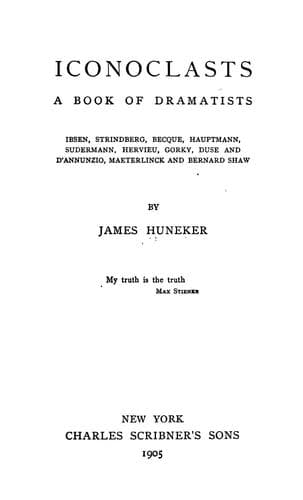
Iconoclasts: A Book of Dramatists: Ibsen, Strindberg, Becque, Hauptmann, Sudermann, Hervieu, Gorky, Duse and D'Annunzio, Maeterlinck and Bernard ShawHuneker, James
History
Iconoclasts: A Book of Dramatists: Ibsen, Strindberg, Becque, Hauptmann, Sudermann, Hervieu, Gorky, Duse and D'Annunzio, Maeterlinck and Bernard Shaw
Huneker, James
Dramatists; European drama -- 19th century -- History and criticism; European drama -- 20th century -- History and criticism
The unfailing brilliancy of expression and abundant technical power
of Hermann Sudermann have so seldom failed him in the lengthy list of
his plays and novels that his admirers are too often oblivious to his
main defect as an artist and thinker--a dualism of style and ideas. The
Prussian playwright wishes to wear three heron feathers in his cap.
Cosmopolitan as he is, he would fill his dramas with the incomparable
psychologic content of Ibsen; he would be a painter of manners; he
would emulate Sardou in his constructive genius. To have failed,
and failed more than once, in his effort to precipitate these three
qualities in his surprisingly bold and delicate wit, is not strange.
And to have grazed so often the edge of triumphs, not popular but
genuinely artistic, warrants one in placing Sudermann high in the ranks
of German dramaturgists.
In a very favourable review written by Mr. W. S. Lilly of The Joy of
Life, he ranks Sudermann among the great painters of manners, and,
after reading Dame Care and The Cat's Bridge, we are tempted to agree
with the enthusiasm of the English critic. He thus sets down the
qualities of a painter of manners: "Sense and sensibility, sagacity
and suppleness, openness of mind and originality of thought, depth
of feeling and delicacy of touch." Does Sudermann's art include all
these things? We think not. Rather is he as a dramatist--the expert
_Techniker_, the man of the theatre, impregnated by the dominant
intellectual ideas of the hour, than a poet who from a haunting
necessity gazes into his heart and then writes: Sudermann is too
photographic; he too often wills his characters into a mould of his
own, not of their own, making; he wills his atmosphere to blend with
his theses, the reverse of Hauptmann's method. He is more cerebral than
emotional, more of a philosopher than a dramatic psychologist. Above
all, he is literary; he has the literary touch, the formal sense, the
up-gushing gift of verbal expression. Add to this order of talent a
real feeling for dramatic _nuance,_ and Sudermann's enigmatic warring
opposites of temperament and action seem remarkable.
In 1889, miraculous year of modern artistic Germany, Sudermann's
dramatic début in Honour was more of a nine days' wonder than
Hauptmann's Before Sunrise. The surety of touch, the easy mastery of
theatric effects, the violent contrasts, and the sparkling dialogue
transformed Sudermann's cometary career into a fixed star of the first
magnitude. To-day this first play appears banal enough. Time has
permitted us to see it in completer historic perspective. Ibsen's
influence in the posing of the moral conflict is speedily recognized,
just as Count Von Trast may be traced to those _raisonneurs_ so dear to
the younger Dumas, those human machines spouting logic and arranging
the dénouement like the god behind the cloud. One inevitably recalls
the relation of Björnsen to Ibsen in the present position of Sudermann
and Hauptmann.
Public-domain text, read in full here on John Shaqi.
Reviews
Reviews
No reviews yet
Be the first to share your thoughts on this work.
Elsewhere in the archive
Join the Discussion
Join the discussion
Sign in to leave a comment or review.
Sign InorCreate an account