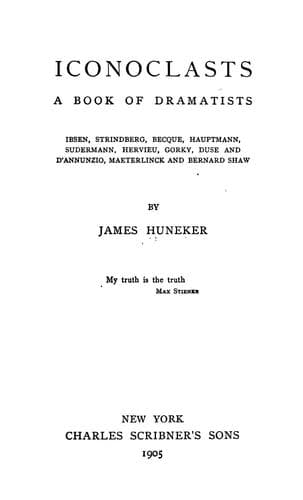
Iconoclasts: A Book of Dramatists: Ibsen, Strindberg, Becque, Hauptmann, Sudermann, Hervieu, Gorky, Duse and D'Annunzio, Maeterlinck and Bernard ShawHuneker, James
History
Iconoclasts: A Book of Dramatists: Ibsen, Strindberg, Becque, Hauptmann, Sudermann, Hervieu, Gorky, Duse and D'Annunzio, Maeterlinck and Bernard Shaw
Huneker, James
Dramatists; European drama -- 19th century -- History and criticism; European drama -- 20th century -- History and criticism
Yet it is easy to admire Honour. It contains, notably in the two
acts of the "hinter haus," real strokes of observation and profound
knowledge of human nature. The elder Heinecke, rapacious rascal, is
a father lost to all sense of shame, for he closes his eyes to his
daughter's behaviour. This same old scamp is both true and amusing.
Nor is his wife depicted with less unwavering fidelity. The motive
of Honour is not alone the ironic contrast of real and conventional
ideals of honour--it shoots a bolt toward Nietzsche's land where good
and evil blend in one hazy hue. Sudermann, here and in nearly all
his later pieces, challenges the moral law--Ibsen's loftiest heron
feather--and if any appreciable theory of conduct is to be deduced from
his works, it is that the moral law must submit to the variations of
time and place, even though its infraction spells sin, even though the
individual in his thirst for self-seeking smashes the slate of morality
and perishes in the attempt.
This battle of good and evil Sudermann dwells upon, often to the
confusion of moral values, often to the tarnishing of his art. And
in his endeavour to hold the dramatic scales in strict equipoise,
to intrude no personal judgments, he leaves his audiences in blank
bewilderment. Better the rankest affirmations than the blandest
negatives. Yes counts far more than No in the theatre, and Sudermann
is happier when he is violently partisan. His contemporary, Hauptmann,
shows us the shipwreck of souls in whom the spiritual stress
preponderates. Sudermann, except in rare instances, sticks closer to
the social scale and its problems; and when he does he is at his best,
for it cannot be said that The Three Heron Feathers, written under
the spur of The Sunken Bell, betrays a mastery or even a familiarity
with those shadowy recesses wherein action is a _becoming_, where the
soul blossoms from a shapeless mass into volitional consciousness.
Sudermann's art is more external; it concerns itself with the How
rather than with the Why, and one feels that storm and fury were
deliberate engraftments, not the power which works from within to the
outer world.
Public-domain text, read in full here on John Shaqi.
Reviews
Reviews
No reviews yet
Be the first to share your thoughts on this work.
Elsewhere in the archive
Join the Discussion
Join the discussion
Sign in to leave a comment or review.
Sign InorCreate an account