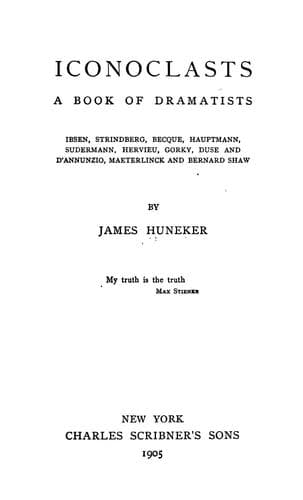
Iconoclasts: A Book of Dramatists: Ibsen, Strindberg, Becque, Hauptmann, Sudermann, Hervieu, Gorky, Duse and D'Annunzio, Maeterlinck and Bernard ShawHuneker, James
History
Iconoclasts: A Book of Dramatists: Ibsen, Strindberg, Becque, Hauptmann, Sudermann, Hervieu, Gorky, Duse and D'Annunzio, Maeterlinck and Bernard Shaw
Huneker, James
Dramatists; European drama -- 19th century -- History and criticism; European drama -- 20th century -- History and criticism
There is character drawing of an unexceptional kind in Honour. Robert
Heinecke returns from foreign lands to find his family degraded, his
sister trading on her beauty, his father and mother accepting bounty
from the mansion house, the employers of the honourable son. The
maze in which he is caught is constructed with infinite skill; the
expository act is the best. There is not much mystery--we seem here
to be in the clear atmosphere of the French dramaturgists, Augier and
Dumas; while the finale is rather flat, we look for a suicide or a
scandal of some sort. The author keeps himself steady in the saddle
of realism. This ending is lifelike, inasmuch as the hero goes away
with Graf Trast, who literally reasons him out of his dangerous mood.
We feel that all the rest do not count, not the ignoble Kurt and his
snobbish friends, his philistine parents; not the Heineckes with their
vulgar avarice, their Zola-istic squalor. The romance is conventional.
In fact, so cleverly did Sudermann mingle the new and old in the
opposing currents of dramatic art that his play was instantly a success.
Accused of this ambition to drive two horses, the dramatist threw
down as a gauge to criticism, Sodom (1891). It was not a great play,
because it lacked logic, balance, truthfulness. A distorted picture of
artistic degeneracy, its satire on certain circles in Berlin caused a
furore; but the piece had not the elements of sincerity. Technically
it revealed the mastery of almost hopeless material, and while one's
æsthetic sense and the fitness of things are hopelessly upset, the
cunning hand of the prestidigitator is everywhere present. There are
some episodes that stir, notably the scenes between father and son; but
the grimness and sordidness are too much for the nerves.
Magda (1893) struck a new note. Many believe it to be Sudermann at
his best. Thus far he has not surpassed it in unity of atmosphere and
dissection of motives. That the _morale_ may be all wrong is not to
the point. Again we see Ibsen's mighty shadow in the revolt of the new
against the old; daughter and father posed antagonistically with the
figure of the pastor, one of the German author's better creations, as a
mediating principle.
One of many reasons that the Magda of Sudermann is a remarkable play
is the critical controversy over its interpretation. Each one of
us reveals his temperamental bias in the upholding of Bernhardt's
or Duse's or Modjeska's respective readings. And which one of the
three artists has exhausted the possibilities of Magda's many-sided
character? On this point Herr Sudermann is distressingly discreet,
although he has a preference for Duse, as is well known to a few of
his intimates. The reason is simple. Duse presents more phases of the
character, exhibits more facets of this curious dramatic gem, and by
her excellences, and not her limitations, we must judge her performance.
Public-domain text, read in full here on John Shaqi.
Reviews
Reviews
No reviews yet
Be the first to share your thoughts on this work.
Elsewhere in the archive
Join the Discussion
Join the discussion
Sign in to leave a comment or review.
Sign InorCreate an account