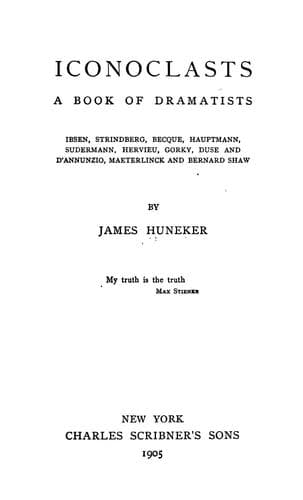
Iconoclasts: A Book of Dramatists: Ibsen, Strindberg, Becque, Hauptmann, Sudermann, Hervieu, Gorky, Duse and D'Annunzio, Maeterlinck and Bernard ShawHuneker, James
History
Iconoclasts: A Book of Dramatists: Ibsen, Strindberg, Becque, Hauptmann, Sudermann, Hervieu, Gorky, Duse and D'Annunzio, Maeterlinck and Bernard Shaw
Huneker, James
Dramatists; European drama -- 19th century -- History and criticism; European drama -- 20th century -- History and criticism
We have seen a dozen Magdas: English, French, German, Italian,
Belgian, Jewish, and Scandinavian. Fanatical admirers of Bernhardt
claim preeminence for her in the part, certain sides of which are
child's play for her accomplished virtuosity. But the critic who
knows Sudermann's Magda also knows that the very brilliancy of the
glorious French actress throws the picture into too high relief; there
are no middle tints in Sarah's embodiment. It recalls the playing
of an overmasteringly brilliant pianist, one who rolls over the
keyboard like a destructive avalanche. The human note, the sobbing,
undulating quality of a violoncello whose tone flashes fire, is
missing. Little doubt that Bernhardt gives us certain moods of Magda
in a transcendental manner. She is the supreme artist of all in the
exposition of tragic _bravura._ Yet she is not Sudermann's Magda. This
is so well known as to be a critical commonplace.
Mrs. Campbell's Magda is above the ordinary. Modjeska's powers were on
the wane when she appeared in the play; but we cannot forget the native
sweetness and true Polish _zal_ with which she suffused the character.
Supple, poetic, charming, she was, and despite all, lacked much of
Magda's complexity. Does Duse entirely fulfil all the requirements of
the rôle?
We do not know. We only feel that in mood-versatility she outstrips
all others we have seen, and if she has not seen farthest into the
soul of the opera singer, she has viewed it from more sides than her
contemporaries. Hence her interpretation is more various and, it being
Duse, is more wonderful in the technical sense in the revelation of an
effortless art.
She is natural, never photographic. Photography arrests motion; Duse
is ever in modulation. Rather, if you will have pictorial analogues,
might her Magda be compared to a Richard Earlom or a Valentine Green
mezzotint, wherein the luminous shadows and faint spiritual overtones
are acidly mellow. And who shall forget the manner of her throat
as it trilled with rage when to her Von Keller makes his perfectly
honourable and perfectly abominable offer! We have dwelt so much upon
the admirable reticences of this artist, upon her "tact of omission,"
we really forget that she never stops acting or living her part for a
moment. She continually evokes musical imagery, for the exquisite and
harmonious interrelations of every movement, every word, unroll before
us like great, solemn music.
Magda will probably outlive The Joy of Life, as it has already outlived
the dramatist's Honour. The theme of the first is based on more
fundamental facts than the others--the clash of will and affection. If
all human families were loving, if father never opposed daughter or
son flouted mother, then such a play as Magda never would have been
written. But, alas! the newspapers prove that family life is not always
celestial, indeed, that it is often bestial. But the Parson Tickletexts
never acknowledge this.
Public-domain text, read in full here on John Shaqi.
Reviews
Reviews
No reviews yet
Be the first to share your thoughts on this work.
Elsewhere in the archive
Join the Discussion
Join the discussion
Sign in to leave a comment or review.
Sign InorCreate an account