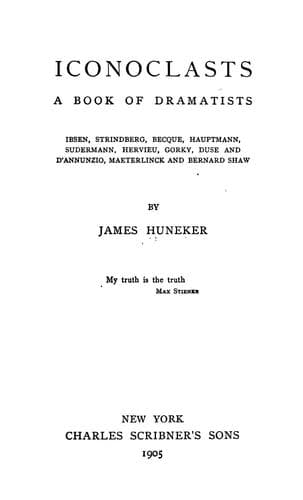
Iconoclasts: A Book of Dramatists: Ibsen, Strindberg, Becque, Hauptmann, Sudermann, Hervieu, Gorky, Duse and D'Annunzio, Maeterlinck and Bernard ShawHuneker, James
History
Iconoclasts: A Book of Dramatists: Ibsen, Strindberg, Becque, Hauptmann, Sudermann, Hervieu, Gorky, Duse and D'Annunzio, Maeterlinck and Bernard Shaw
Huneker, James
Dramatists; European drama -- 19th century -- History and criticism; European drama -- 20th century -- History and criticism
There is no lesson in Magda; the ending is not a sermon--unless you
wish it to prove that contradicting apoplectic fathers is a fatal
proceeding. Magda is an individualist. She is selfish. This trait
she shares with the mass of mankind. Her "I am I" is neither a
proclamation nor a challenge to the world. It is the simple confession
of a woman who knows herself, her weaknesses, her errors, who has
battled and wrested from life a little, passing triumph, the stability
of which she doubts.
"We must sin if we wish to grow. To become greater than our sins is
worth more than all the purity you preach." Is this immoral? We hasten
to quote a sentence from John Milton's Areopagitica, the magnificent
music of which fascinated the ear of Robert Louis Stevenson, quite
apart from its significant wisdom.
"I cannot praise a fugitive and cloistered virtue, unexercised and
unbreathed, that never sallies out and sees her adversary, but
slinks out of the race where that immortal garland is to be run for,
not without dust or heat." Poor Magda's virtue was certainly not
cloistered. She ran for fame's garland in all the dust and heat of
the artistic arena. She won, she lost. The bigot discerns in Magda an
abandoned creature; the men and women who see life from all sides and
know the fallibility of the flesh are apt to forgive her shortcomings.
"The ghost of a linen decency yet haunts us." She must have had a
detestable disposition. Fancy what a spoilt opera singer with sore
tonsils can be on a rainy day, especially when she reads the name of
her dearest foe "substituting" on the bill. Then drop her in the sleepy
old town of her nativity, where a harsh, opinionated father would worm
from her every detail of her dubious past Sudermann has done this with
the result--a lifelike play, in which nothing is demonstrated except
the unalterable stupidity of things in general and the naked fact that
"I am I" is the only motto, whether secret or published, of every
human crawling 'twixt earth and sky. In the pastor Sudermann attempts
to paint the altruist in action. It is hardly a convincing piece of
portraiture. Your true altruist is bounded by Tolstoy on the north, by
Howells on the west, by Francis of Assisi on the south, and on the east
by Buddha. Outside of book covers the person exists not.
Public-domain text, read in full here on John Shaqi.
Reviews
Reviews
No reviews yet
Be the first to share your thoughts on this work.
Elsewhere in the archive
Join the Discussion
Join the discussion
Sign in to leave a comment or review.
Sign InorCreate an account