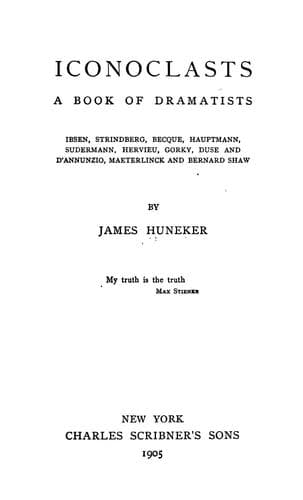
Iconoclasts: A Book of Dramatists: Ibsen, Strindberg, Becque, Hauptmann, Sudermann, Hervieu, Gorky, Duse and D'Annunzio, Maeterlinck and Bernard ShawHuneker, James
History
Iconoclasts: A Book of Dramatists: Ibsen, Strindberg, Becque, Hauptmann, Sudermann, Hervieu, Gorky, Duse and D'Annunzio, Maeterlinck and Bernard Shaw
Huneker, James
Dramatists; European drama -- 19th century -- History and criticism; European drama -- 20th century -- History and criticism
The Three Heron Feathers (1899) is an attempt to meet Hauptmann on
equal terms. It lacks coherence, despite the occasional lift of
its verse--Sudermann fancied that he had forsworn the prose of the
realistic drama forever--while the lofty moral ideal, unduly insisted
upon, soon becomes a thorn in the flesh. No one is alive but the trusty
Lorbuss, the Prince being a theory set in action. The next play, St.
John's Fire (1900), we confess to having read with more pleasure than
seeing it enacted. It goes up in the air soon after the curtain rises
on Act III, though the story is a capital one for dramatic purposes. It
would seem that Sudermann was again attacked by his doubting mania. He
has contrived the atmosphere of romance, the pagan fire of St. John,
the mystery of night, the passion of Georg and Marikke; but either his
courage failed him, or else beset by some idea of resignation he spoilt
his development and conclusion, and we leave the theatre dissatisfied,
not with that spiritual dissatisfaction which Ibsen plants, a
rankling sore in one's heart, but the kind that grows into resentment
against the dramatist, for Marikke is a girl of whom Thomas Hardy
would have been proud. And then there is a muddle of symbolism and
heredity,--Sudermann endeavouring to scoop up in his too comprehensive
net the floating ideas of the hour. Georg von Hartwig's sudden lapse
into a selfish citizen we can never forgive.
Of the criticism of masterpieces there is no end. Take Sudermann's The
Joy of Life as an example. (Why such an Ibsen-like title for Es Lebe
das Leben?) Obsessed by subject and subject-matter only, many of us
turn a blind side to the real qualities that make up an excellent play.
Now this harping on the theme of a drama--whether pleasant, unpleasant,
dull, brilliant, or truthful--is eminently amateurish. It is rather
the function of the manager; it affects his box-office, and, as he is
not in business for art, he cherishes that brave little place above
all else. But a critic is supposed to wear an open mind, to accept a
subject without looking the gift poet in the mouth, and also to judge
how near the dramatist reaches the goal of his own ideal--not the
critic's. That we do not do so is to be pitied. It is because of this
that so many wonderful plays never see the light, or else are botched
at their birth.
This persistent avoidance of the dramatist's view-point, this
refusal to enter into sympathetic complicity with him, leads to sad
conclusions. If you decide violently that a play has no right to exist
because it exhibits a situation or character abhorrent to your notions,
in what a predicament is the dramatist! It recalls the story told by
George Saintsbury about the man who was shown Flameng's beautiful
etching of Herrera's Child with the Guitar. "But I don't like babies,"
said the man, unconsciously illustrating uncatholicity in criticism.
The subject did not appeal to him, therefore its truthful art could go
hang.
Public-domain text, read in full here on John Shaqi.
Reviews
Reviews
No reviews yet
Be the first to share your thoughts on this work.
Elsewhere in the archive
Join the Discussion
Join the discussion
Sign in to leave a comment or review.
Sign InorCreate an account