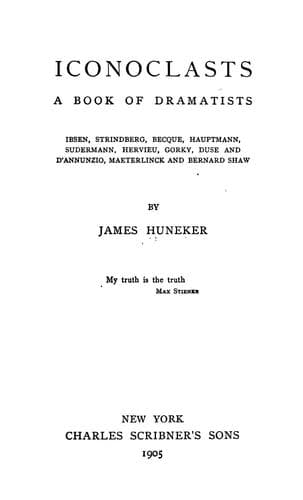
Iconoclasts: A Book of Dramatists: Ibsen, Strindberg, Becque, Hauptmann, Sudermann, Hervieu, Gorky, Duse and D'Annunzio, Maeterlinck and Bernard ShawHuneker, James
History
Iconoclasts: A Book of Dramatists: Ibsen, Strindberg, Becque, Hauptmann, Sudermann, Hervieu, Gorky, Duse and D'Annunzio, Maeterlinck and Bernard Shaw
Huneker, James
Dramatists; European drama -- 19th century -- History and criticism; European drama -- 20th century -- History and criticism
Too great an artist to preach a moral, Sudermann nevertheless bestows
the justice demanded by destiny upon the luckless Beata, Countess of
Michael von Kellinghausen. The Joy of Life is next to Magda technically
one of Sudermann's biggest achievements.
To present such a trite theme with new harmonies is a triumph.
The tragic quality of the piece in an atmosphere bordering on the
aristocratic commonplace is not the least of its excellences. We know
that life is daily, that great art is rare, that the average sensual
man prefers a variety show to a problem play; yet we are not abashed
or downcast. The cant that clusters about cults, theatric or artistic,
should not close our ears to the psychologic power and the message--if
you will have the word--of this Sudermann play. If his Beata,--Ibsen
has a Beata in Rosmersholm and D'Annunzio one in his La Gioconda--was
a sorely beset woman, if she felt too much, thought too much,--one
suspects her of poring over Nietzsche and hearing much Wagner; witness
that allusion to Hans Sachs's quotation from Tristan,--yet is she not
a fascinating soul? Are there to be no semi-tones in character? Must
women be paragons and men perfect for inclusion in a play? If this be
so, then all the art of the Elizabethans is false, their magnificent
freedom and their wit a beacon of warning to pure-minded playwriters.
And, pray, out of what material shall the dramatist weave his pattern
of good and evil?
But had Sudermann transposed his Beata to the fourteenth century,
had he dowered her with mediæval speech and the name of Beatrice,
had he surrounded her with lovers in tin-plate armour, our shrinking
natures might not have hied to cover. The pathos of distance would
have softened the ugly truths of the modern drawing-room. The Joy of
Life is a capital play. There is much conventionality displayed in the
minor characters; only Beata and Richard are really original. And the
use of the divorce debate as a symbol reveals the real weakness of
the play, though structurally it has some striking virtues. The small
part of Meixner, the theological student turned social-democrat, had
_vraisemblance_. It suggests the character of Krogstad in A Doll's
House. That tiresome exhorter, Count Trast, in Sudermann's Honour,
is luckily not duplicated. And we doubt not that the absence of
explicatory comment by the author is disheartening to a public which
likes all the questions raised answered at the close, after the manner
of a Mother Goose morality. Neither D'Annunzio nor Sudermann is a
preacher. As in the ghastly illumination of a lightning flash, souls
hallucinated by love, terror, pity, despair, are seen struggling in
the black gulf of night. And then all becomes abysmal darkness. There
are the eternal verities, the inevitable compensations in this play.
The application of the moral is left to the listener, who is given
the choice of echoing or not echoing the immortal exclamation of Mr.
Saintsbury's unknown, "But I don't like babies!"
Public-domain text, read in full here on John Shaqi.
Reviews
Reviews
No reviews yet
Be the first to share your thoughts on this work.
Elsewhere in the archive
Join the Discussion
Join the discussion
Sign in to leave a comment or review.
Sign InorCreate an account