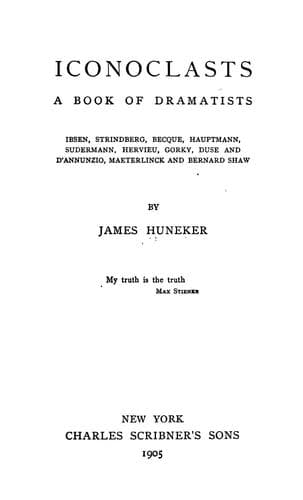
Iconoclasts: A Book of Dramatists: Ibsen, Strindberg, Becque, Hauptmann, Sudermann, Hervieu, Gorky, Duse and D'Annunzio, Maeterlinck and Bernard ShawHuneker, James
History
Iconoclasts: A Book of Dramatists: Ibsen, Strindberg, Becque, Hauptmann, Sudermann, Hervieu, Gorky, Duse and D'Annunzio, Maeterlinck and Bernard Shaw
Huneker, James
Dramatists; European drama -- 19th century -- History and criticism; European drama -- 20th century -- History and criticism
In Storm-Brother Socrates, Sudermann places his scene in a small East
Prussian town, possibly Matizken, where he was born in 1857. The
schoolmaster, the grocer, the Jewish rabbi, the tax-collector, and
the dentist are the chief characters of this satiric comedy. A lot of
old cronies, men who went through the stirring times of '48, form a
revolutionary guild, calling themselves "The Brotherhood of the Storm."
Harmless enough, they still declaim against Bismarck--the time of
action is twenty years ago--and talk of their warlike exploits. As the
dramatist is preeminently a painter of manners, many of his portraits
are masterly. The dentist, Hartmayer, is a hater of tyranny and an
idealist. He has assumed the name of Socrates, his companions selecting
such stirring pseudonyms as Catiline, Giordano Bruno, Spinoza, and
Poniatowski. This dentist's son' Fritz has adopted the same profession;
and being called to attend a reigning prince's dog for toothache, he is
denounced by his anti-imperialist of a father. But Fritz is a socialist
and has no prejudices on the subject of canine gums. Another brother,
an impudent lad, is a conservative. When the archives of the Bund fall
into the hands of the local magistrate, the old man is thoroughly
miserable. His associates fly and he, expecting arrest, is decorated
for the services of his son in saving an aristocratic dog's teeth! He
accepts, and the curtain falls on a rather discursive, ill-natured
comedy. However, Sudermann's virtuosity has plenty of opportunity for
display.
The minor characters are well sketched. The waitress, Ida, is an
exceedingly vital figure, as is the innkeeper. The dialogue is
Sudermann almost at his best,--witty, sarcastic, ironical, tersely
vigorous, and true to life. Like Daudet and Flaubert, Sudermann loves
to prick the bloated German bourgeois. There is a little Hebrew,
named, from sheer cruelty, Siegfried Markuse. His description of his
freshman visits to a _Corps-Kneipe_ at the Königsberg University is a
fair example of the playwright's powers of unerring observation.
Public-domain text, read in full here on John Shaqi.
Reviews
Reviews
No reviews yet
Be the first to share your thoughts on this work.
Elsewhere in the archive
Join the Discussion
Join the discussion
Sign in to leave a comment or review.
Sign InorCreate an account