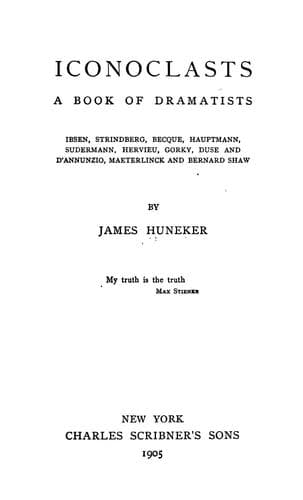
Iconoclasts: A Book of Dramatists: Ibsen, Strindberg, Becque, Hauptmann, Sudermann, Hervieu, Gorky, Duse and D'Annunzio, Maeterlinck and Bernard ShawHuneker, James
History
Iconoclasts: A Book of Dramatists: Ibsen, Strindberg, Becque, Hauptmann, Sudermann, Hervieu, Gorky, Duse and D'Annunzio, Maeterlinck and Bernard Shaw
Huneker, James
Dramatists; European drama -- 19th century -- History and criticism; European drama -- 20th century -- History and criticism
The late Princess Mathilde Bonaparte meant many things to many people.
Her ancestry, her marriage to Prince Demidoff, her political power at
the Tuileries, her sympathetic patronage of artistic folk, her personal
beauty, love affairs, and feminine caprices--all these serve the
world as pleasing material for anecdotes. The Princess was fond of the
theatre, and fonder still of a _première_ when the play was written by
one of her intimate circle. She was surrounded by a distinguished group
of poets, painters, dramatists, novelists, and diplomats. De Morny
called her "the man of the family." She was good to gaze upon, and she
had intellect. After the death of Sainte-Beuve, the publication of her
correspondence with that celebrated critic gave us a portrait of his
friend. It occurs in Lettres de la Princesse:--
"The Princess has a high, noble forehead, and her light golden hair,
leaving uncovered on each side broad, pure temples, is bound in wavy
masses on the full, finely shaped neck. Her eyes, which are well set,
are expressive rather than large, gleam with the affection of the
thought of the moment, and are not of those which can either feign
or conceal. The whole face indicates nobleness and dignity, and, as
soon as it lights up, grace united to power, frankness, and goodness;
sometimes, also, it expresses fire and ardour. The head, so finely
poised and carried with such dignity, rises from a dazzling and
magnificent bust, and is joined to shoulders of statuesque smoothness
and perfection."
That description should cover a multitude of indiscretions, such as the
publication of the letters. She had already given Taine his _congé_
for his criticism of Napoleon in the _Revue des Deux Mondes_, She was
the daughter of Jerome and Caroline of Wurttemberg and was as proud as
Napoleon. She never forgave an offence, and Taine's conception of the
First Consul as a superior bandit closed her doors upon him.
She stood with forced equanimity the first two of his masterly studies;
at the third she exclaimed with true feminine _finesse_ of cruelty:--
"Ah, I know what I shall do! I owe Mme. Taine a call. I shall leave my
card with P.P.C., which will mean that I take leave of him forever. I
cannot allow a friend to attack violently the head of my family, the
man without whom I should perhaps be nothing but a little orange-vender
on the bridge at Ajaccio." She put her threat into execution. Taine,
shocked by the rupture, called on Renan. After hearing the tale without
any comment but a sweet, ironical smile, Renan answered:--
"_ Cher ami_, I have quarrelled with a much greater lady than the
Princess Mathilde."
"With whom, then?"
"The Church," answered Renan, dryly.
Public-domain text, read in full here on John Shaqi.
Reviews
Reviews
No reviews yet
Be the first to share your thoughts on this work.
Elsewhere in the archive
Join the Discussion
Join the discussion
Sign in to leave a comment or review.
Sign InorCreate an account