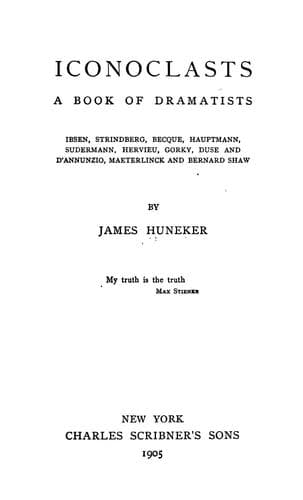
Iconoclasts: A Book of Dramatists: Ibsen, Strindberg, Becque, Hauptmann, Sudermann, Hervieu, Gorky, Duse and D'Annunzio, Maeterlinck and Bernard ShawHuneker, James
History
Iconoclasts: A Book of Dramatists: Ibsen, Strindberg, Becque, Hauptmann, Sudermann, Hervieu, Gorky, Duse and D'Annunzio, Maeterlinck and Bernard Shaw
Huneker, James
Dramatists; European drama -- 19th century -- History and criticism; European drama -- 20th century -- History and criticism
Mathilde did not respect rank more than genius. She set her face
against the free and easy democratic manners, and because of this
disliked the American invasion--few of our countrymen crossed her
doors. One night Edmond About was invited to her house, and during
the trying moments before dinner he amused her with his wit. Suddenly
the Count Nieuwerkerke appeared. "Go away," cried the novelist, "and
let us be alone, you jealous fellow." The Princess arose, rang, and
instructed the servant: "Conduct M. About to his carriage. He is not
dining here to-night." And the man of the Broken Ear went away, his
temper much ruffled.
In 1847 the Princess settled in Paris permanently. She had been
divorced from the handsome, profligate Demidoff, and her allowance, a
big one, had been given her by a decree from the Czar. Over Napoleon
III she wielded great influence. Of him the De Goncourts said, "The
Emperor would be an excellent somnambulist if only he had intervals of
lucidity;" while Flaubert declared him to be clever because, knowing
his ignorance, he had the wisdom to hold his tongue. The Empress
Eugénie was always jealous of Mathilde's power with her imperial
cousin. That she was at the latter's funeral is an illustration of
life's topsy-turvy tricks. Eugénie was jealous also of the Castiglione,
and the De Goncourts do not fail to register Constance's spiritual
_mot_ about the Emperor.
"If I had only resisted, to-day I should have been an Empress!"
This recalls the delightful answer made by Alfred de Musset to a famous
actress of the Théâtre Français--is it necessary to give the name? Once
the lady had said:--
"Monsieur de Musset, I hear you have boasted of being my lover." "I beg
your pardon," answered the friend of Rachel and George Sand; "I have
always boasted to the contrary."
The rupture of Mathilde Bonaparte and Sainte-Beuve took place in 1869.
The brothers De Goncourt heard its details from the Princess. They
found her still trembling from the stormy interview. "I shall never
see him again--never again! I, who fell out with the Empress on his
account!... He has gone over to the _Temps_, our personal enemies! Ah!
I said to him, 'Monsieur Sainte-Beuve, listen! I am sorry you did not
die last year, for I should then have mourned a friend.'"
She must have been difficult at times. She had a good opinion of
her birth, wealth, position, and beauty. "Yes, I had a peculiar and
most extraordinary complexion. I remember in Switzerland, when I was
fourteen, they put a Bengal rose leaf on my cheek, and were unable to
distinguish between the two."
Public-domain text, read in full here on John Shaqi.
Reviews
Reviews
No reviews yet
Be the first to share your thoughts on this work.
Elsewhere in the archive
Join the Discussion
Join the discussion
Sign in to leave a comment or review.
Sign InorCreate an account