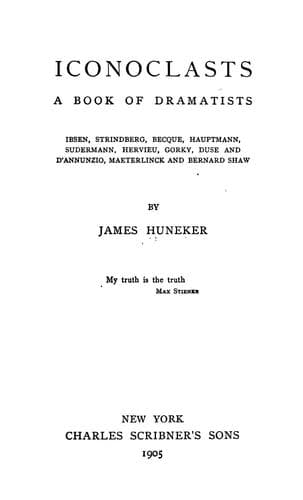
Iconoclasts: A Book of Dramatists: Ibsen, Strindberg, Becque, Hauptmann, Sudermann, Hervieu, Gorky, Duse and D'Annunzio, Maeterlinck and Bernard ShawHuneker, James
History
Iconoclasts: A Book of Dramatists: Ibsen, Strindberg, Becque, Hauptmann, Sudermann, Hervieu, Gorky, Duse and D'Annunzio, Maeterlinck and Bernard Shaw
Huneker, James
Dramatists; European drama -- 19th century -- History and criticism; European drama -- 20th century -- History and criticism
It is a mistake, too, to think that their novels and plays are immoral
or hinge always on the eternal triangle. Various passions are treated
by them in their air-tight receiver; their methods of psychological
evisceration recall the laboratory of an analytical chemist. In
Germinie it is the degradation of a woman through weakness; in Madame
Gervaisais--that Odyssey of a woman's soul--it is the mystic passion
for religion; in Manette Salomon, art and woman and their dangers to
the impressionable artistic temperament; Charles Demailly pictures
the gulfs of despair into which the literary, the poetic soul may be
plunged; Sœur Philomène shows the combat between religious vows
and nature; and so on through a wide gamut. And these two nervous
artists have been mockingly called maniacs, their work has been derided
as inutile--that work which practically reconstructed the artistic
life of the eighteenth century and discovered to itself the artistic
soul of the nineteenth. If they had remained normal units of their
class, they would have gambled, shot pigeons, sported mistresses, and
dabbled in racing, drinking, and the other sterilities of fashionable
life. They preferred art, and they were rewarded in the usual
fashion. The singular thing is that they expected, ingenuous souls,
encouragement from their world. Fame came only when Jules was dead
and Edmond too old and embittered to appreciate it. The survivor saw
his ideas appropriated by Zola and the younger crowd, and cheapened
and coarsened beyond all likeness to the original. What, then, must
have been the dismay and perplexity of the brothers when they heard
the hissing, catcalls, groans, and yells of an organized clique sworn
to kill Henriette Maréchal? The body of the house was not hostile;
but politics, the Republican opposition to the patronage of the
Bonapartes, aroused students on the other side of the Seine, and a
scandalous scene, only equalled by the Parisian productions of Hernani
and Tannhäuser, occurred. Strangely enough, Théophile Gautier, who had
figured in the Hernani fracas, had written the prologue to Henrietta
Maréchal, and spoke it without opposition from the malcontents, though
he was the librarian of Princess Mathilde. Not a word could be heard
in any of the scenes, and when Got, the comedian who played in the
cast,--the rest were Delaunay, the Lafontaines, Arnould-Plessis,
Bressant, and other distinguished artists,--appeared to announce, as
was the custom, the authors' names, he stood for ten minutes unable to
make himself heard in the terrific hubbub. The Journal of the brothers
contains a minute account of the affair, and of their terror as they
stood, pale, breathless, peeping out upon a disordered sea of human
faces. After all, it is a joy, despite its frequent injustice, to see
a community take its drama seriously and not merely as a first aid to
digestion.
Public-domain text, read in full here on John Shaqi.
Reviews
Reviews
No reviews yet
Be the first to share your thoughts on this work.
Elsewhere in the archive
Join the Discussion
Join the discussion
Sign in to leave a comment or review.
Sign InorCreate an account