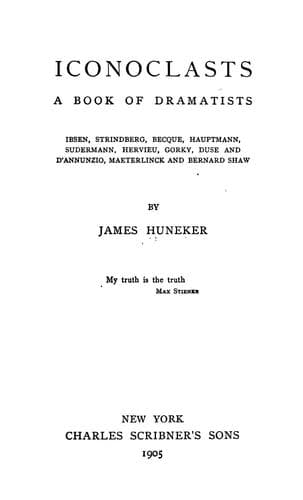
Iconoclasts: A Book of Dramatists: Ibsen, Strindberg, Becque, Hauptmann, Sudermann, Hervieu, Gorky, Duse and D'Annunzio, Maeterlinck and Bernard ShawHuneker, James
History
Iconoclasts: A Book of Dramatists: Ibsen, Strindberg, Becque, Hauptmann, Sudermann, Hervieu, Gorky, Duse and D'Annunzio, Maeterlinck and Bernard Shaw
Huneker, James
Dramatists; European drama -- 19th century -- History and criticism; European drama -- 20th century -- History and criticism
The De Goncourts had the satisfaction a few weeks later to hear
Molière's Précieuses Ridicules hissed by the same mob believing that it
was Henrietta Maréchal.
Reading this play to-day one can see that its novelties must have
provoked hostility, though such critics as Jules Janin, Gautier,
Sarcey, Uhlbach, Nestor Roqueplan, Paul de Saint-Victor, and others
wrote impartial and enthusiastic criticisms. The middle-aged woman who
loves a young man was not pleasing upon the boards, and her daughter's
death at the pistol of her father caused a shudder; for it was the rank
side of adultery exhibited without that pleasing gloze of sentiment so
dear to the average Gallic playwright and public. Naturally politics
caused the row, for Princess Mathilde had steered the play into the
notice of M. Thierry. The speeches are too long and the action moves
languidly. Perhaps, after he had surveyed the situation in a calmer
mood, Edmond de Goncourt was impelled to write his preface espousing
the methods of Meilhac and Halévy. He said, among other acute things,
that the avarice in Molière's play, L'Avare, was "l'avarice bouffe"
when compared with the powerful and compelling study made by Balzac of
Père Grandet.
He also records the cynical remark of a well-known actress who, after
listening to the æsthetic _blague_ in a well-known literary group,
broke forth with this apostrophe, "Vous êtes jeunes, vous autres, mais
le théâtre au fond, mes enfants, c'est l'absinthe du mauvais lieu," and
to his dying day Edmond de Goncourt called the theatre a place for the
exercises of educated dogs or an exhibition of marionettes spouting
their tirades. Between these extremes he thought there was a place
where artistic spirit might be displayed in a dignified and beautiful
style. But he never found that place, despite his poignant finale, when
Henrietta declares that her mother's lover is her own.
Contrast this effective, if too heroic, dénouement with the cold
cynicism of Maurice Donnay in L'Autre Danger, where a pure girl is
forced by cruel circumstances to hear her mother's shame published, to
learn the awful news that the man she loves is the lover of her mother,
and, to cap this assault upon our nerves, the lover is made to marry
the wretched girl so as to divert suspicion from the inhuman mother.
In the grip of his dark pessimism Edmond de Goncourt predicted that in
fifty years the book would kill the theatre. It was about nine years
later that Ernest Renan, according to Octave Uzanne, said one evening
in conversation among friends, "Fifty years hence no one will open a
book." Both prophecies are likely to come to naught. Bad books, bad
plays, we shall always have with us. Life seems too brief for the
larger cultivation of beautiful art.
X
DUSE AND D'ANNUNZIO
I
ELEONORA DUSE!
Public-domain text, read in full here on John Shaqi.
Reviews
Reviews
No reviews yet
Be the first to share your thoughts on this work.
Elsewhere in the archive
Join the Discussion
Join the discussion
Sign in to leave a comment or review.
Sign InorCreate an account