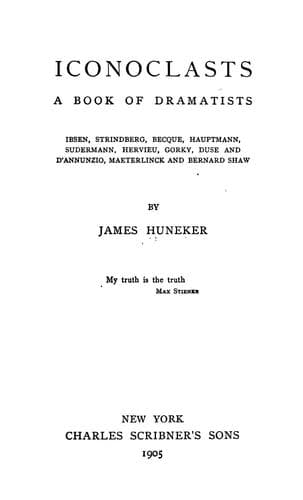
Iconoclasts: A Book of Dramatists: Ibsen, Strindberg, Becque, Hauptmann, Sudermann, Hervieu, Gorky, Duse and D'Annunzio, Maeterlinck and Bernard ShawHuneker, James
History
Iconoclasts: A Book of Dramatists: Ibsen, Strindberg, Becque, Hauptmann, Sudermann, Hervieu, Gorky, Duse and D'Annunzio, Maeterlinck and Bernard Shaw
Huneker, James
Dramatists; European drama -- 19th century -- History and criticism; European drama -- 20th century -- History and criticism
When this extraordinary woman first came to New York in January,
1893, she attracted a small band of admirable lunatics who saw her
uncritically as a symbol rather than as an actress. Some of us went
to fantastic lengths in our devotion. She was Our Lady of Evil, one
of Baudelaire's enigmatic women; Mater Malorium, a figure out of De
Quincey's opium-stained dreams; she was not only superior to Sarah of
the Sardou régime, but the true successor to Rachel. This semi-absurd
jumbling of Poe, Swinburne, Baudelaire, and the Elizabethans--what
a tremendous Duchess of Malfi we fancied Duse would make!--was not
altogether the fabric of fantasy. Nor was personality the strongest
asset in her art. She had suffered academic training; she had practised
when young all the scales of thumb-rule theatricalism; she had played
Cosette when a child and knew Electra. The apprenticeship then had been
exhausting, the thirty-six situations she had by heart, a long race
of play actors determined her vocation, and yet she rose superior to
all these things, to experiences that would have either crushed or made
mechanical the average artist. Life with its disillusionments was the
sculptor that finally wrought the something precious and strange we
recognize in Eleonora Duse.
Without especial comeliness, without the golden ductile voice of
Bernhardt, Duse so drilled her bodily organs that her gestures,
angular if executed by another, become potent instruments; her voice,
once rather thin, siccant, now gives a soft, surprised speech; and
her face is the mirror of her soul. Across it flit the agonies, the
joys, of the modern anæmic, overwrought woman. She excels in the
delineation of listless, nervous, hysterical, and half-mad souls. She
passes easily from the passionate creatures of Dumas and Sardou to
the chillier-blooded women of Ibsen and Sudermann, unbalanced and out
of tune with their surroundings. Shall we ever forget her reading of
Vladimir's letter in Fédora? And yet her assumption of the Russian
was a tour-de-force of technic; temperamentally the rôle belongs to
the hotter-tongued Bernhardt. With Santuzza, a primitive nature,
she accomplished wonders. That miserable, deserted girl, in a lowly
Sicilian village, with her qualms of conscience, her nausea, her hunted
looks--here was Verga's heroine stripped of all Mascagni's rustling
music, the soul showing clear and naked against the sordid background
of Cavalleria Rusticana.
Public-domain text, read in full here on John Shaqi.
Reviews
Reviews
No reviews yet
Be the first to share your thoughts on this work.
Elsewhere in the archive
Join the Discussion
Join the discussion
Sign in to leave a comment or review.
Sign InorCreate an account