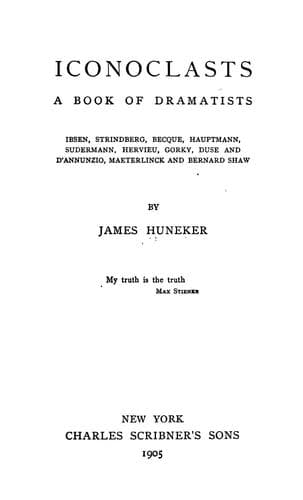
Iconoclasts: A Book of Dramatists: Ibsen, Strindberg, Becque, Hauptmann, Sudermann, Hervieu, Gorky, Duse and D'Annunzio, Maeterlinck and Bernard ShawHuneker, James
History
Iconoclasts: A Book of Dramatists: Ibsen, Strindberg, Becque, Hauptmann, Sudermann, Hervieu, Gorky, Duse and D'Annunzio, Maeterlinck and Bernard Shaw
Huneker, James
Dramatists; European drama -- 19th century -- History and criticism; European drama -- 20th century -- History and criticism
The slinking ferocity of Cesarine's entrance into her husband's
atelier; the scene with Antonine; the interview of Camille with
Armand's father; the gracious gayety of Goldoni's La Locandiera; that
hideous battle of an exasperated man and woman before the closed
doors in Fernande; Magda's wonderful blush as she meets Kellar, the
cold-hearted prig, who ruined her--all these stale situations and
well-worn types, Magda being an honourable exception, Duse literally
re-created. In them we felt the power of her intellect, the magic of
the woman. And she stared tradition in the face by refusing to "make
up," unconcealing her own hair and doing nothing to restrict the
plasticity of her figure. Now she wears wigs, uses rouge discreetly,
for her hair is gray and her face more matured. But her art is broader,
though losing none of its former subtlety. There is more weight, more
brilliancy, in her action and gesture, and that doubtless prompted some
critics to compare her to Sarah Bernhardt. But she is still Eleonora
Duse, the woman with the imagination, the glance, and the beautiful
hands.
The wisdom of her choice in selecting only D'Annunzio's dramas is not
altogether apparent. She will listen to no advice; perhaps she is on
a mission; perhaps she wishes to make known everywhere the genius of
her young countryman, and to go back with the means to raise upon the
border of Lake Albano a great independent theatre, the poet's dream
of a dramatic Bayreuth. The D'Annunzio plays are not of the kind that
appeal to the larger public. For the student of contemporary drama they
are of surpassing interest in their freedom from conventional stage
trickery and characterization; La Gioconda, La Citta Morta, are really
lyric masterpieces in little, though many will wince at the themes,
at their bold development and treatment. When floated on the wings of
Richard Wagner's mighty music in Die Walküre, the incestuous loves of
Siegmund and Sieglinde are applauded; prose, be it as polished and
as sonorous as D'Annunzio's, has not the same privilege as music. So
the motto of Catulle Mendès for a playhouse has a point, "Abandon all
reality ye who would enter here." And D'Annunzio never falters before
harsh reality, as those who have read his romances well know. In each
of his plays we assist at the toilette of a woman's soul.
Public-domain text, read in full here on John Shaqi.
Reviews
Reviews
No reviews yet
Be the first to share your thoughts on this work.
Elsewhere in the archive
Join the Discussion
Join the discussion
Sign in to leave a comment or review.
Sign InorCreate an account