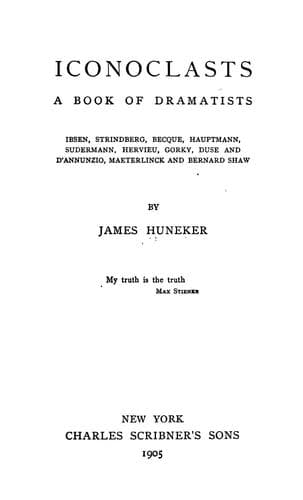
Iconoclasts: A Book of Dramatists: Ibsen, Strindberg, Becque, Hauptmann, Sudermann, Hervieu, Gorky, Duse and D'Annunzio, Maeterlinck and Bernard ShawHuneker, James
History
Iconoclasts: A Book of Dramatists: Ibsen, Strindberg, Becque, Hauptmann, Sudermann, Hervieu, Gorky, Duse and D'Annunzio, Maeterlinck and Bernard Shaw
Huneker, James
Dramatists; European drama -- 19th century -- History and criticism; European drama -- 20th century -- History and criticism
Duse's art, however, covers a multitude of D'Annunzio's
morbidities--everything that does not derive from bread and butter,
children in arms, politics, dog-shows and gowns, is adjudged morbid
by a world that feeds on divorce scandals, crimes of the day, and the
diversions of multi-millionnaires. D'Annunzio, who does not pretend to
be a mere painter of manners, is given over entirely to the portraying
of the primary passions. This Swinburne of Italy became famous in
his sixteenth year (he was born in 1864, and his real name is said to
be Gaetano Rapagnetto). Since then he has succeeded the poet Carducci
in the affections of a certain public, though his poetic ancestry may
be easily traced to Shelley, Baudelaire, Carducci, and Stecchetti.
From verse he passed to prose, writing in a highly coloured, fluid
style a group of novels called The Romances of the Rose, Lily, and
Pomegranate. The Triumph of Death is the best known to English and
American readers, though Fuoco--The Flame of Life--set wagging
the tongues of the curious by its carefully exposed portraits of a
celebrated Italian actress and D'Annunzio himself. In that astonishing
performance, the taste of which can be hardly gauged by any but Latin
standards, one of the D'Annunzio plays--The Dead City--is set forth
in detail. Whether the betrayal of a woman's soul--for D'Annunzio is
a true soul-hunter--was made with the concurrence of the subject, no
one seems to know. Of the psychologic value of the study there can be
but one opinion. It is unique, it is painful, it is appallingly true.
D'Annunzio now enjoys a European reputation. His art, despite its
exquisite workmanship, is still a gallery of echoes. He has absorbed
all contemporary culture, and so chiselled is his prose that he has
been called "the Italian Flaubert." A profound student of the classics,
he is rich in his scholarly allusions. The late Pope is said to have
delighted in the melodious thunder-pool of his style. From Balzac,
Flaubert, Zola, Bourget, Daudet, Maeterlinck, Tolstoy, and Dostoïevsky
he has absorbed much; while he evidently knows the English classics.
Some of his dramatic figures seem to have stepped out of John Webster
or John Ford's pages. In his short tales, Novelle della Pescara, he
has utilized a number of De Maupassant's themes, in an individual
manner; but the assimilation is complete. Compare La Ficelle and
Foire de Candea--the transposition of character and place are most
deftly accomplished, as a writer in the _Mercure de France_ has shown.
That D'Annunzio has chosen to depict decadent men and women, and all
bristling with vitality, is his personal idiosyncrasy. His chief defect
is an absolute lack of humour, and this, coupled with the tropical
quality of his art, causes a certain monotony--we breathe a dense,
languorous atmosphere. Human interest in the daily sense of the phrase
is often absent. He loves nature. He describes her lovingly. His formal
Public-domain text, read in full here on John Shaqi.
Reviews
Reviews
No reviews yet
Be the first to share your thoughts on this work.
Elsewhere in the archive
Join the Discussion
Join the discussion
Sign in to leave a comment or review.
Sign InorCreate an account