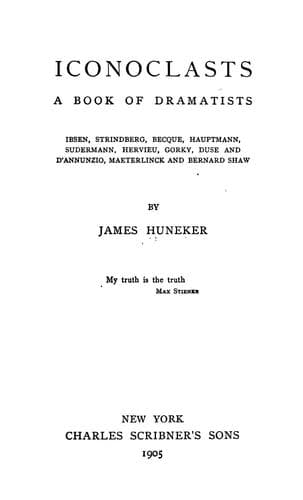
Iconoclasts: A Book of Dramatists: Ibsen, Strindberg, Becque, Hauptmann, Sudermann, Hervieu, Gorky, Duse and D'Annunzio, Maeterlinck and Bernard ShawHuneker, James
History
Iconoclasts: A Book of Dramatists: Ibsen, Strindberg, Becque, Hauptmann, Sudermann, Hervieu, Gorky, Duse and D'Annunzio, Maeterlinck and Bernard Shaw
Huneker, James
Dramatists; European drama -- 19th century -- History and criticism; European drama -- 20th century -- History and criticism
And now D'Annunzio, as if he wished to demonstrate his fitness in
the handling of any dramatic form, conceived and executed a species
of poetic melodrama in which the life of a feudal period is unrolled
before us in five glowing tableaux. Prodigality of colour, bloody war,
horrid lusts, are mingled artistically with the processional attitudes
of tirewomen, sweet singing, and interludes of lyric passion. As in
a mirrored dream of Burne-Jones, Francesca moves slowly from rapt
maidenhood to forced marriage; from unhappy marriage to deception and
death. Not content to follow the bare lines of the ancient chronicle,
the playwright weaves into his symphony of adulterous passion historic
episodes and pictures of manners. It is one epoch of strange, repellent
contrasts. Souls are danced to the tune of graceful madrigals, and
roses often dyed a deeper hue by blood. In the sphere of action the
play mostly lives, though there are some halting moments of poetic
delicacy and introspection set over against operatic episodes. We
first assist at a scene of jester and damsels which recalls Bandello
or Boccaccio. It is gay and humorous, with the coarse, unseemly humour
of the time. Alberich, teased by the three mermaids in Rheingold, is
recalled. Two brothers of Francesca indulge in fierce recriminations
during which a veiled accusation of attempted parricide is made, with
the result that murder is barely escaped.
Francesca is deliberately betrayed by her brother, Ostasio Polenta,
into the arms of the "Lamester" Giovanni Malatesta. She believes that
she is wedding his brother Paolo, called the handsome one, skilled in
the fine arts, of goodly presence, a warrior and a lover of sport. By
a device near the close of Act I he is made to pass and be seen by
Francesca. She goes to her doom willingly. She loves, but does not know
that Paolo is a married man.
In the second act, a year later, Francesca, in a Saracenic headdress,
seems to have aged ten years. On the battlement of her husband's
fortress, amid the enginery of war, Greek fire boiling in the caldron,
darts flaming, missiles, catapults, ballista, and outlandish weapons
that crowd the summit of the tower, she stands. There is a terrific
din; crossbows twang, shoutings and tocsins are heard. Francesca,
displaying true mediæval immobility at all these sights and sounds,
hovers about the platform, questioning, curious.
She insists on tampering with a torch of the deadly Greek fire, and
it evokes from the poet a flock of his flaming images that Swinburne
alone might parallel. As Paolo enters, eager for the fight, Francesca's
attitude shifts. At once we see her aroused interest. She loved him,
loves him. Their interview contains some striking speeches. "And then I
saw your face, silent between the spears of the horsemen," she tells
him, and adds that then she longed for death. He replies in a like
exalted strain. He exposes himself at the open portcullis, and she
trembles but is brave.
Public-domain text, read in full here on John Shaqi.
Reviews
Reviews
No reviews yet
Be the first to share your thoughts on this work.
Elsewhere in the archive
Join the Discussion
Join the discussion
Sign in to leave a comment or review.
Sign InorCreate an account