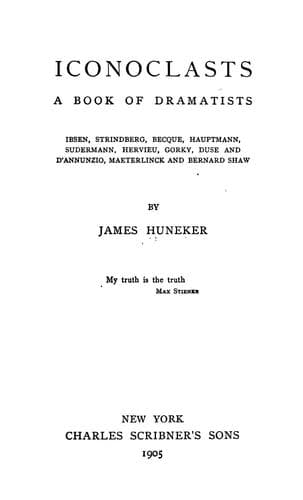
Iconoclasts: A Book of Dramatists: Ibsen, Strindberg, Becque, Hauptmann, Sudermann, Hervieu, Gorky, Duse and D'Annunzio, Maeterlinck and Bernard ShawHuneker, James
History
Iconoclasts: A Book of Dramatists: Ibsen, Strindberg, Becque, Hauptmann, Sudermann, Hervieu, Gorky, Duse and D'Annunzio, Maeterlinck and Bernard Shaw
Huneker, James
Dramatists; European drama -- 19th century -- History and criticism; European drama -- 20th century -- History and criticism
Her Pater Noster is an outlet for her overcharged feelings. It was
delivered by Duse with shivering eloquence. The intensity of the scene
is heightened by the entrance of her husband, surnamed Gianciotto. He
limps, but is a mighty warrior in the land. The characters of the two
brothers are exposed in a few lines. Still another brother appears,
Malatestino. He is the youngest. His eye has just been destroyed during
this battle. Malevolent, cruel, he too loves Francesca. In a later act
he plays the part of Iago to his elder brother.
Act III is in the earlier half both a picture and a promise. Little
happens. We see Francesca in a rare room, with the Adriatic Sea
glimpsed through the open windows. This scene is beautifully presented.
Upon a unique lectern is placed a tome, The History of Launcelot of
the Lake, the very book mentioned by Dante as the fatal one. There
are girlish jesting and chattering. Francesca reads aloud. It may be
noticed that at the beginning of Act I the old romance of Tristan and
Isolde is alluded to, thus suggesting the ultimate ending of Francesca
and Paolo.
Throughout there are these delicate loops of leading motives binding
firmly the somewhat loosely built dramatic tale. Francesca relates her
dream to her slave, Smaragdi. It is of a pursuit through dim woods of a
naked woman by a savage knight and his mastiffs. The vision always ends
in the same manner. The knight cuts out her heart and throws it to the
hungry dogs; they devour it.
The entrance of a voluble merchant and later an astrologer and the
jester relaxes the tense melancholy of the love-lorn lady. A scene of
bright foolery follows. It is touched by no little fancy. And then the
slave whispers that Paolo is without. Sending away her people, she
receives him. There is the inevitable duo of amorous despair and the
fateful reading. Here D'Annunzio handles a foreseen situation with
poetic skill. He manages to create an atmosphere of suspense from the
beginning. The final cry of Francesca, "No, Paolo!" is worth a page of
overwrought adjectives and writhing embraces.
Act IV, the cruellest of the five, is devoted to the arousing of
Giovanni's suspicions. This is easily accomplished by Malatestino, the
wicked younger brother. Jealous of Paolo, he shocks Francesca with his
hints, his hot advances, and the hideous cruelty he exhibits in cutting
off the head of a prisoner. He drags on the stage the head, enveloped
in a bag. It is heavy, he remarks. Oddly enough, D'Annunzio manages
matters so that we sympathize with the deceived husband--rather an
un-Latin proceeding.
Public-domain text, read in full here on John Shaqi.
Reviews
Reviews
No reviews yet
Be the first to share your thoughts on this work.
Elsewhere in the archive
Join the Discussion
Join the discussion
Sign in to leave a comment or review.
Sign InorCreate an account