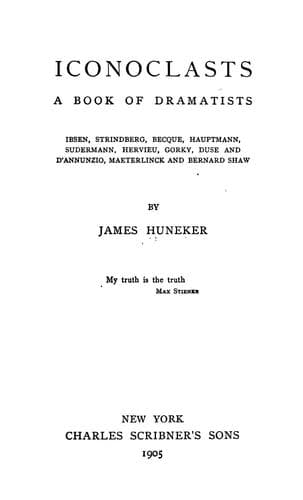
Iconoclasts: A Book of Dramatists: Ibsen, Strindberg, Becque, Hauptmann, Sudermann, Hervieu, Gorky, Duse and D'Annunzio, Maeterlinck and Bernard ShawHuneker, James
History
Iconoclasts: A Book of Dramatists: Ibsen, Strindberg, Becque, Hauptmann, Sudermann, Hervieu, Gorky, Duse and D'Annunzio, Maeterlinck and Bernard Shaw
Huneker, James
Dramatists; European drama -- 19th century -- History and criticism; European drama -- 20th century -- History and criticism
In the final act D'Annunzio, we feel, has Shakespeare before him. The
scene of Othello is evoked at once, not in incident, but because of
the spiritual, tragic atmosphere. Francesca is asleep; she moans, for
she dreams. Her maidens are sent away. Her slave is called, but comes
not. Tricked by this plotted absence, Paolo enters. The lovers are soon
caught and slain by Giovanni, who breaks his sword across his knee.
Every detail is admirably managed.
Not the least potent factor is the absence of all remorse shown by
Francesca. The victim of deceit, she does not hesitate to deceive
in return. In her love passages, Duse was truthful to a degree. She
invested Francesca with just the proper poise, dignity, and suppressed
melancholy.
Francesca da Rimini is the first of D'Annunzio's dramatic efforts that
attracted popular favour. It is an interesting rather than a great
play, though full of inspiring poetry. It was first given, December 9,
1901, at Teatro Costanzi, Rome, by the Duse Company, with the exception
that Gustavo Salvini was the Paolo on that occasion.
IV
Compared to La Gioconda, The Dead City is a highly polished specimen
of the static drama; there is little that is dynamic until the
scene before the last. And the theme, thunder-charged as it is with
symbolism, is fitter for reading than for publication before the
footlights. The play is literature first, drama afterward. Sarah
Bernhardt produced it in Paris.
Incest as a subject for dramatic treatment is no new thing. The
Greeks employed it as a leit-motive of horror, and in the Œdipus
of Sophocles, the Hippolytus of Euripides--we recall with grateful
memories Bernhardt's puissant Phèdre in Racine's paraphrase of the
Greek dramatist--and in the Bible itself this dire theme may be
encountered, though no modern has had the courage to set the episode
of Tamar and Amnon in the Book of Samuel. Later, in the flush of
the seventeenth-century dramatic renascence, John Ford wrote his
masterpiece, The Brother and Sister.
In that play, admired of Charles Lamb, is set forth with a wealth of
realism undreamed of by D'Annunzio and the Greeks the details of a
lamentable passion, and so cunning is the art of Ford that we find
ourselves pitying the unhappy pair, Giovanni and Annabella, poor
play-things of the gods. Of Wagner's Die Walküre it is unnecessary to
speak. Music, as Henry James remarks, is a great solvent.
But mark the handling of the young Italian poet. Obsessed by the
Greeks, he has constructed his tragedy on antique lines. Crime is
hinted at; we even see an adulterous love--for evil passions hunt in
couples throughout this dream-like story--in development; almost is a
catastrophe precipitated. The incest, however, is potential. It is
only an idea. It scourges the two men like whips in the hands of the
avenging Furies. And it finally dooms an innocent creature, hopelessly
involving at the same time the happiness of three survivors.
Public-domain text, read in full here on John Shaqi.
Reviews
Reviews
No reviews yet
Be the first to share your thoughts on this work.
Elsewhere in the archive
Join the Discussion
Join the discussion
Sign in to leave a comment or review.
Sign InorCreate an account