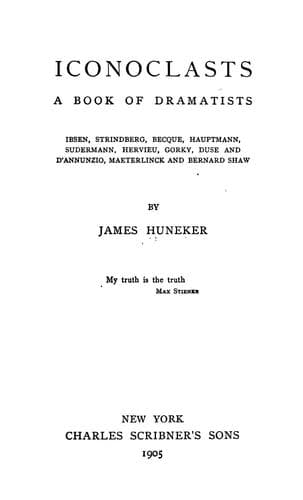
Iconoclasts: A Book of Dramatists: Ibsen, Strindberg, Becque, Hauptmann, Sudermann, Hervieu, Gorky, Duse and D'Annunzio, Maeterlinck and Bernard ShawHuneker, James
History
Iconoclasts: A Book of Dramatists: Ibsen, Strindberg, Becque, Hauptmann, Sudermann, Hervieu, Gorky, Duse and D'Annunzio, Maeterlinck and Bernard Shaw
Huneker, James
Dramatists; European drama -- 19th century -- History and criticism; European drama -- 20th century -- History and criticism
A mystic among mystics, yet his linen was not always impeccable.
Verlaine, another son of the stars and sewers, wrote, "I am far from
sure that the philosophy of Villiers will not one day become the
formula of our century." "Know, once and for all, that there is for
thee no other universe than that conception which is reflected at the
bottom of thy thoughts"--this utterance of Villiers is the keystone
of his system. In Elën (1864), his greatest drama, another idea comes
to the surface in the dialogue of Samuel and Goetze. Samuel speaks:
"Science will not suffice. Sooner or later you will end by coming to
your knees." Goetze: "Before what?" Samuel: "Before the darkness."
His life long, Villiers traversed the darkness which encompasses with
the sure, swift step of a nyctalops, one who can pierce with his
glance the deepest obscurity. So it is that in his plays and stories
we are conscious of the great mystery of life and death hemming us
about. Sometimes this atmosphere is morbidly oppressive, sometimes
it is relieved by gay, maniacal bursts of laughter. Again it lifts
and reveals the mild heavens streaked with menacing irony. There is a
lugubrious undercurrent in the buffooneries of Villiers. Philip Hale
has translated the cruel story of the swans massacred by fear. This
poet slew his soul by his evocation of terror.
He is a mystic, a spiritual romantic, and only a realist in his
sardonic pictures of Paris life, tiny cabinet pictures, etchings,
bitten out with the _aqua fortis_ of his ghastly irony. There is the
irony, a mask behind which pity, sympathy, lurk; Shakespeare wore this
mask at times. And there is the irony that withers, that blasts. This
is Villiers.
Axel is both difficult and illuminative reading. It is in four acts
with nine scenes. Each act or part is respectively entitled: The
Religious World, The Tragic World, The Occult World, The Passional
World. The poet had not known Wagner and his Tetralogy for naught. Sara
is a superb creation--but not on the boards, in the disillusioning,
depoetizing, troubled, and malarial air of the stage! It was a mistake
to play Axël in Paris. Its solemn act of rejection of life al the
moment "when life becomes ideal" is hardly fitting for the theatre. A
drama to be played by poets before a parterre of poets! Arthur Symons
has noticed with his accustomed acuity that "the modern drama under the
democratic influence of Ibsen, the positive influence of Dumas _fils_,
has limited itself to the expression of temperaments in the one case,
of theoretic intelligences in the other, in as nearly as possible the
words which the average man would use for the statement of his emotions
and ideas. The form, that is, is degraded below the level of the
characters whom it attempts to express."
Public-domain text, read in full here on John Shaqi.
Reviews
Reviews
No reviews yet
Be the first to share your thoughts on this work.
Elsewhere in the archive
Join the Discussion
Join the discussion
Sign in to leave a comment or review.
Sign InorCreate an account