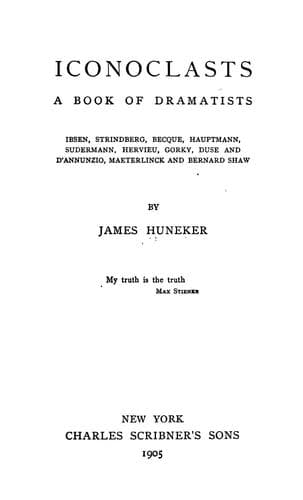
Iconoclasts: A Book of Dramatists: Ibsen, Strindberg, Becque, Hauptmann, Sudermann, Hervieu, Gorky, Duse and D'Annunzio, Maeterlinck and Bernard ShawHuneker, James
History
Iconoclasts: A Book of Dramatists: Ibsen, Strindberg, Becque, Hauptmann, Sudermann, Hervieu, Gorky, Duse and D'Annunzio, Maeterlinck and Bernard Shaw
Huneker, James
Dramatists; European drama -- 19th century -- History and criticism; European drama -- 20th century -- History and criticism
It is a point well taken, though I feel inclined to rebel at the
pinning down of form to language alone. Ibsen's terseness--and remember
we only see him in the cold light of Mr. Archer's translations--is one
of his merits; but his form, his dramatic form, is not alone in his
text, but in the serene and ordered procession of his dramatic action.
Villiers is more poetically eloquent than the Ibsen of the prose
dramas. But as logical or as dramatic--!
Mr. Symons adds, "La Révolte, which seems to anticipate A Doll's
House, shows us an aristocratic Ibsen, touching reality with a certain
disdain, certainly with far less skill, certainly with far more
beauty." For me in a play of character the beauty that appeals is not
purely verbal. It is the beauty of character _quâ_ character, and the
beauty of events marshalled like a great sequence of mysterious music,
humming with the indefinable harmonies of life. Ibsen makes this music;
so does Gerhart Hauptmann. Axël is noble drama, despite its formal
shortcoming, its dream-like quality. Many went begging to Villiers,
and few came away empty-handed. Prodigal in genius, he was prodigal in
giving.
This poet, like most poets, loathed mediocrity. He sought the
exceptional, the complex soul. "A chacun son infini," he said; and
in Axel he cries: "As for living, our servants will do that for us!
As at the play in a central stall, one sits out so as not to disturb
one's neighbours--out of courtesy, in a word--some play written in a
wearisome style of which one does not like the subject, so I lived,
out of politeness." Here is the gauge cast disdainfully to those who
forever pelt us with sweet phrases about loving our neighbour, about
altruism, sympathy, and social obligations--all the self-illuding,
socialistic cant, in a word, that rankles in the breast of the solitary
proud man and poisons the mind of the weak. Villiers is the exorcist of
the real, the bearer of the ideal, wrote De Gourmont, himself a poetic
individualist. And he sums up, "Villiers knew all forms of intellectual
intoxication."
Villiers associated much with Richard Wagner, and with Baudelaire was
an ardent upholder of the new music during the troubled times of the
Tannhäuser _fiasco_. He played the piano, knew the Ring by heart--no
mean feat--and set Baudelaire's poems to music, anticipating Charles
Martin Loeffler by nearly a half-century. Of one of them the music is
said to be still extant. It is the poem with this couplet:--
Our beds shall be scented with sweetest perfume, Our divans be as cool
and dark as the tomb.
Public-domain text, read in full here on John Shaqi.
Reviews
Reviews
No reviews yet
Be the first to share your thoughts on this work.
Elsewhere in the archive
Join the Discussion
Join the discussion
Sign in to leave a comment or review.
Sign InorCreate an account