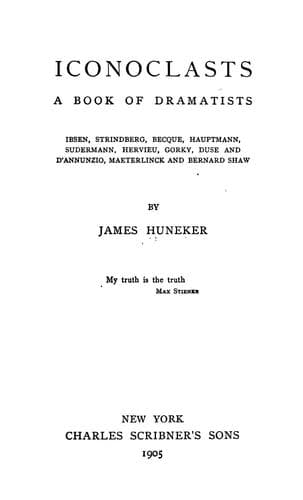
Iconoclasts: A Book of Dramatists: Ibsen, Strindberg, Becque, Hauptmann, Sudermann, Hervieu, Gorky, Duse and D'Annunzio, Maeterlinck and Bernard ShawHuneker, James
History
Iconoclasts: A Book of Dramatists: Ibsen, Strindberg, Becque, Hauptmann, Sudermann, Hervieu, Gorky, Duse and D'Annunzio, Maeterlinck and Bernard Shaw
Huneker, James
Dramatists; European drama -- 19th century -- History and criticism; European drama -- 20th century -- History and criticism
Probably the most lifelike, verbal portrait of Wagner is that of
Villiers's. In a memorable passage, which I commend to Mr. Finck
as testimony with which to snub recalcitrant clergymen and others,
Villiers notes Wagner's violent disclaimer that his Parsifal was
merely the work of the artist and not of the believing Christian.
"Why, if I did not feel in my inmost soul the living light and love of
that Christian faith, my works ... would be the works of a liar and
an ape. My art is my prayer." Thus Villiers reports Wagner--Wagner,
whose marvellous soul changed colour every moment, like one of those
exquisite flying fishes which paint the air and waters of the tropics.
In 1861, at Baudelaire's home, Villiers met Richard Wagner. It was at
a period of great depression for that master. Villiers speaks of the
interview as the most memorable of his life. "Wagner, with his high,
remarkable forehead, almost terrifying in its development; his deep
blue eyes, with their slow, steady, magnetic glance; his thin, strongly
marked features, changing from one shade of pallor to another; his
imperious hooked nose; his delicate, thin-lipped, unsatisfied, ironic
mouth; his exceedingly strong, projecting, and pointed chin--seemed to
Villiers like the archangel of celestial combat." A rare little band,
composed of Wagner, Villiers, Baudelaire, and Catulle Mendès, often
walked the town after midnight. Once they were down along a dreary
street which ends at the Quai Saint-Eustache, and there Wagner pointed
out to them the window of a garret at the top of a very high house.
In it he said he almost starved, despaired, even meditated suicide.
Villiers was a Wagnerian among Wagnerians. He paraphrased in words his
impressions of the German's music, and some of these were published in
Catulle Mendès's _Revue Fantaisiste_. He visited Wagner at Triebchen,
near Lucerne, in Switzerland, although he was so poor that he had to
walk part of the distance.
Public-domain text, read in full here on John Shaqi.
Reviews
Reviews
No reviews yet
Be the first to share your thoughts on this work.
Elsewhere in the archive
Join the Discussion
Join the discussion
Sign in to leave a comment or review.
Sign InorCreate an account