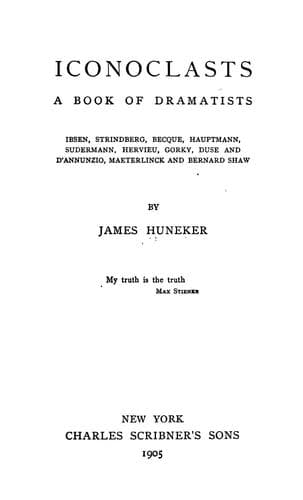
Iconoclasts: A Book of Dramatists: Ibsen, Strindberg, Becque, Hauptmann, Sudermann, Hervieu, Gorky, Duse and D'Annunzio, Maeterlinck and Bernard ShawHuneker, James
History
Iconoclasts: A Book of Dramatists: Ibsen, Strindberg, Becque, Hauptmann, Sudermann, Hervieu, Gorky, Duse and D'Annunzio, Maeterlinck and Bernard Shaw
Huneker, James
Dramatists; European drama -- 19th century -- History and criticism; European drama -- 20th century -- History and criticism
One of Villiers's characters was Triboulat Bonhomet. This was the man
who was so avid of new sensations in music that he cruelly slew swans.
During the autumn of 1879 Villiers was at Bayreuth in company with
Judith Gautier and Catulle Mendès, and gave a reading from his works
before a lot of crowned heads, Wagner and Liszt included. He read some
of the curious adventures of Bonhomet, and was surprised to hear his
audience laugh, at first quietly, at last unrestrainedly. At last the
tempest of laughter rose so high that the reader ceased and cast a
glance full of vague suspicion round his, audience. The Grand Duke
of Saxe-Weimar, who sat beside him, touched his shoulder and pointed
to a person sitting just opposite them. Villiers, with a little sharp
cry, dropped the manuscript from his trembling fingers and gave evident
signs of lively terror. There in front of him, surrounded by a bevy of
beautiful women, gazing at him with shining eyes, his enormous mouth
opened in stentorian laughter, his huge hands leading applause, was Dr.
Triboulat Bonhomet himself, flesh and bone. It was Franz Liszt!
From the very first line of the manuscript, in which Villiers had
minutely described the doctor, the whole audience had been struck by
the resemblance between the great pianist and Triboulat Bonhomet, and
as the description went on the likeness increased--dress, gestures,
habits, all bore a striking similarity. One person alone did not
perceive the identity, and he laughed louder than the rest--Liszt
himself. Finally the reading had to be stopped on account of the
general hilarity, but Liszt was never told of the joke.
The most curious episode in the life of Villiers was when he won a
prize with his five-act play, The New World. A dramatic competition was
announced by the theatrical press of Paris. A medal of honour and ten
thousand francs were offered to the French dramatic author who would
"most powerfully recall in a work of four or five acts the episode
of the proclamation of the independence of the United States, the
hundredth anniversary of which fell on July 4, 1876. The two examining
juries were composed as follows: the first, of the principal critics
of the French theatrical press; the second, of Victor Hugo, honorary
president; Emile Augier, Octave Feuillet, and Ernest Legouvé, members
of the French Academy; Mr. Grenville Murray, representing the New York
_Herald_, and M. Perrin, administrator-general of the Théâtre Français."
Public-domain text, read in full here on John Shaqi.
Reviews
Reviews
No reviews yet
Be the first to share your thoughts on this work.
Elsewhere in the archive
Join the Discussion
Join the discussion
Sign in to leave a comment or review.
Sign InorCreate an account