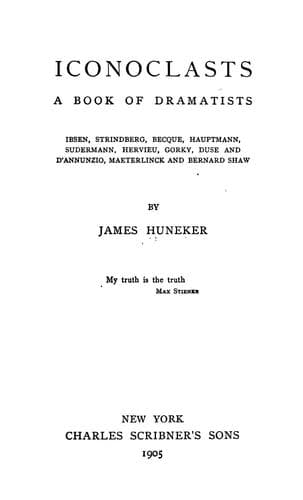
Iconoclasts: A Book of Dramatists: Ibsen, Strindberg, Becque, Hauptmann, Sudermann, Hervieu, Gorky, Duse and D'Annunzio, Maeterlinck and Bernard ShawHuneker, James
History
Iconoclasts: A Book of Dramatists: Ibsen, Strindberg, Becque, Hauptmann, Sudermann, Hervieu, Gorky, Duse and D'Annunzio, Maeterlinck and Bernard Shaw
Huneker, James
Dramatists; European drama -- 19th century -- History and criticism; European drama -- 20th century -- History and criticism
Villiers's play conquered. His New World was passed by both juries. But
through some sort of official devilry he received neither money nor
medal; nor was his play produced. He had the mortification of seeing a
second-rate piece by Armand d'Artois given while his own work collected
dust in the manuscript box of the Porte-Saint-Martin Theatre. Naturally
he raised a hubbub. He bearded the venerable Hugo at his home and there
insulted not only the poet, but also the aged Legouvé. Conflict was
the very breath of this visionary's nostrils. Did he not institute a
ridiculous lawsuit against the author of a play because it vilified,
so he claimed, a very remote ancestor? After interminable processes he
was non-suited. And The New World was his favourite drama! Villiers had
long dreamed of becoming the Richard Wagner of the drama.
His cousin says: "His idea was that the characteristics of the nation,
or of the event which was to be portrayed, should be imported into
the framework of some personal intrigue, in which each individual of
the _dramatis personæ_ should personify in his language, attitude, or
actions some one of the numerous elements produced by the friction
of the incidents of the play." Here is the leading motive idea of
Wagner--a dangerous idea in the drama, where the pattern must not be
too regular or too persistent. Villiers dreamed of a symphonic drama
with a densely woven web. Poets seldom realize the bigness of that
hollow frame, the theatre, on the background of which they must paint
in bold, splashing colours, or else pay the penalty of not being seen
at all. It is scene, not miniature, painting which is the real art of
the drama.
In sooth, The New World is a play that would puzzle the most sanguine
manager. It has been called "one of the best constructed, deepest, and
most passionate dramas of the present day," by a prejudiced witness,
the cousin of the poet. Against the wishes of his true friends,
Villiers allowed a representation, with dire results. Sarcey fairly
peppered it with his wit; so bad were the actors and actresses that the
author himself hissed furiously at every performance. This was at the
Théâtre des Nations, 1883. There were six representations. And such
an America as this poet depicts! It is as illusory, in another way,
as Victor Hugo's England. Villiers had evidently read Chateaubriand's
Atala--Chateaubriand, who cajoled his countrymen men into the belief
that he lived for years in Louisiana!--and so we are given some odd
characters, odd happenings, odder history. Mistress Andrews, the
heroine, is a sort of an American Melusina. Can any one in his most
exalted mood picture an American Melusina?
Public-domain text, read in full here on John Shaqi.
Reviews
Reviews
No reviews yet
Be the first to share your thoughts on this work.
Elsewhere in the archive
Join the Discussion
Join the discussion
Sign in to leave a comment or review.
Sign InorCreate an account