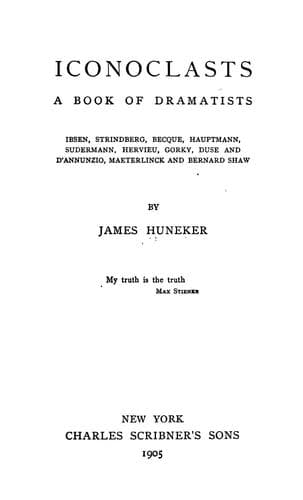
Iconoclasts: A Book of Dramatists: Ibsen, Strindberg, Becque, Hauptmann, Sudermann, Hervieu, Gorky, Duse and D'Annunzio, Maeterlinck and Bernard ShawHuneker, James
History
Iconoclasts: A Book of Dramatists: Ibsen, Strindberg, Becque, Hauptmann, Sudermann, Hervieu, Gorky, Duse and D'Annunzio, Maeterlinck and Bernard Shaw
Huneker, James
Dramatists; European drama -- 19th century -- History and criticism; European drama -- 20th century -- History and criticism
And so this "hybrid, complex, contradictory being, by turns mysterious,
terrible, cynical, innocent, loving, tragic, grotesque" poet, rolled
down the hill of life. Is it not Pascal who says: "The last act is
always tragedy, whatever fine comedy there may have been in the rest
of life. We must all die alone"? Villiers was lonely and dying from
his youth. Death was his intimate companion, sometimes a boon one, but
oftener a consoling friend. The death's-head adorns his wassail time.
Yet this poet actually went into politics, was a candidate at the
elections of the _Conseil Général_, and was, luckily enough, defeated.
One trembles at the idea of this aristocratic anarch among the bleating
law-makers. It is characteristic of him that he accepted his defeat
calmly because his opponent was De Hérédia the poet. _Noblesse oblige!_
Villiers, like most European poets, had formed a mighty ideal
of America and the Americans. He believed this country and its
institutions to be what Thomas Paine, Jefferson, and a few other
genuine patriots hoped it would be. He entertained for Thomas Edison
the deepest admiration. His novel, a grotesque book, The Eve of the
Future, contains a fanciful account of Menlo Park and its "terrifying
proprietor." When Edison went to the Paris exhibition in 1889 he
became acquainted with Villiers's novel. He read it at a sitting and
expressed himself thus: "That man is greater than I. I can only invent.
He creates." He did not meet the author, who was mortally ill, though
an attempt was made to bring the Frenchman and American together.
The leading motive of The Eve of the Future, pushed to an ingenuity
bordering on insanity, is the construction of an artificial woman which
when wound up imitates in every respect the daily life of a cultivated
lady!
J. K. Huysmans became known to Villiers, and his critical recognition
of his genius, tardy though it was, was one of the few consolations
accorded this unhappy man by fate. Huysmans it was who gently persuaded
Villiers to make a deathbed marriage and legitimize his son. His agony
was intensified by the fact that his wife could not sign her name to
the marriage contract, she could only make a cross. The artist in this
dying man persisted to the last. Huysmans with his omnivorous eye has
noted the sigh that escaped from the semi-moribund poet.
Public-domain text, read in full here on John Shaqi.
Reviews
Reviews
No reviews yet
Be the first to share your thoughts on this work.
Elsewhere in the archive
Join the Discussion
Join the discussion
Sign in to leave a comment or review.
Sign InorCreate an account