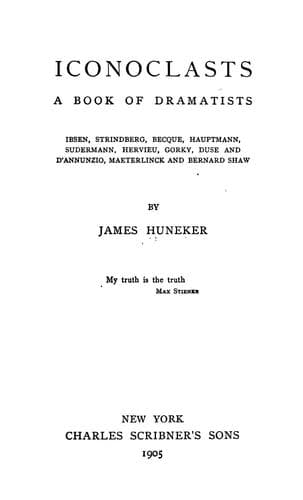
Iconoclasts: A Book of Dramatists: Ibsen, Strindberg, Becque, Hauptmann, Sudermann, Hervieu, Gorky, Duse and D'Annunzio, Maeterlinck and Bernard ShawHuneker, James
History
Iconoclasts: A Book of Dramatists: Ibsen, Strindberg, Becque, Hauptmann, Sudermann, Hervieu, Gorky, Duse and D'Annunzio, Maeterlinck and Bernard Shaw
Huneker, James
Dramatists; European drama -- 19th century -- History and criticism; European drama -- 20th century -- History and criticism
Thus he lived, thus he died, a stranger in a strange world. His plays
may be better appreciated some day. If Ibsen profited by The Revolt,
then the seed of Villiers has not been sown in vain. Nothing reveals
Ibsen's mastery of the dramatic form so completely as his treatment
of the woman who revolts and leaves her home, when compared to
Villiers's handling of the same idea. Elizabeth goes away in despair,
but to return. Nora departs, and the curtain quickly severs us from
her future, her "miracle" speech being a faint prophecy that may be
expanded some day into a fulfilment. Villiers was perhaps the pioneer;
though revolting women abound in Dumas, abound in the Bible, for that
matter; but the specific woman who puts up the shutters of the shop,
and declares the dissolution of the matrimonial firm, is the creation
of Villiers. Ibsen developed the idea, and, great artist that he is,
made of it a formal drama of beauty and dramatic significance--which
The Revolt is not. There are many loose psychologic ends left untied by
the Frenchman, and his conclusion is dramatically ineffectual.
What is the value of such a life, what its meanings? may be asked
by the curious impertinents. Why select for study the character
and career of a half-mad mystic? Simply because Villiers is a poet
and not a politician. It is because Villiers is Villiers that he
interests the student of literature and humanity. And the bravery,
the incomparable bravery, of the man who like Childe Roland blew his
slug-horn, dauntless to the last! In his Azrael he uses as a motto
Hassan-ben-Sabbah's "O Death! those who are about to live, salute
thee." All the soul of Villiers de l'Isle Adam is in that magnificently
defiant challenge!
XII
MAURICE MAETERLINCK
I
The dramatical evolution of Maurice Maeterlinck.
When this Belgian poet, dramatist, mystic, became known in America, his
plays, avowedly written for marionettes, were received with open-eyed
wonder or prolonged laughter. Any idea that he be taken seriously was
scouted by serious critics, and the usual fate befell them-well-meaning
amateurs seized them as legitimate prey. There is no denying the
fact that at one time Maeterlinck meant for most people a crazy crow
masquerading in tail feathers plucked from the Swan of Avon.
But caricature and critical malignity did not retard the growth of this
very remarkable young man--he was born in 1862--and presently we heard
more of him. After we had finished The Treasure of the Lowly, Wisdom
and Destiny, The Buried Temple, and The Double Garden, it was conceded
that a mistake had been made just as in Browning's case. A mystic--yes,
and one who had adjusted his very sensitive scheme of thought to the
practical work-a-day work. A Belgian Emerson, rather than a Belgian
Shakespeare; but an Emerson who had in him much of Edgar Allan Poe.
_Toujours_ Poe, in any consideration of modern continental poets.
Public-domain text, read in full here on John Shaqi.
Reviews
Reviews
No reviews yet
Be the first to share your thoughts on this work.
Elsewhere in the archive
Join the Discussion
Join the discussion
Sign in to leave a comment or review.
Sign InorCreate an account