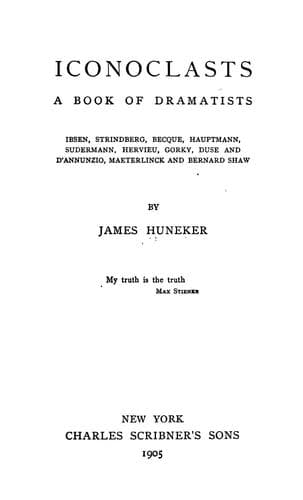
Iconoclasts: A Book of Dramatists: Ibsen, Strindberg, Becque, Hauptmann, Sudermann, Hervieu, Gorky, Duse and D'Annunzio, Maeterlinck and Bernard ShawHuneker, James
History
Iconoclasts: A Book of Dramatists: Ibsen, Strindberg, Becque, Hauptmann, Sudermann, Hervieu, Gorky, Duse and D'Annunzio, Maeterlinck and Bernard Shaw
Huneker, James
Dramatists; European drama -- 19th century -- History and criticism; European drama -- 20th century -- History and criticism
Maeterlinck began with a volume of poems entitled Serres Chaudes,
often compared to the unrhymed, loose rhythmic prose of Walt Whitman.
They do bear a certain superficial resemblance to Whitman's effusions,
though not in idea. It is rather a cataloguing, aimless apparently, of
widely disparate subjects. But the substance derives more from that
extraordinary book of an extraordinary poet, Les Illuminations by
Arthur Rimbaud, than from the ragged, epical lines of Whitman. Take,
for example, the following specimen of Maeterlinck's _âme_ in Serres
Chaudes:--
"One day there was a poor little festival in the suburbs of my soul.
They mowed the hemlock there one Sunday morning, and all the convent
virgins saw the ships pass by on the canal one sunny fast day, while
the swans suffered under a poisonous bridge. The trees were lopped
about the prison; medicines were brought one afternoon in June and
meals for the patients were spread over the whole horizon."
Now read Rimbaud, translated admirably by Aline Gorren: "As soon as
the Idea of the Deluge had sunk back into its place, a rabbit halted
amid the sainfoin and the small swinging bells and said its prayers
to the rainbow, through the spider's web.... The caravans started. And
the splendid hotel was erected upon the chaos of ice and night at the
Pole.... In hours of bitterness I imagine balls of sapphire, of metal.
I am master of the silence. Why should the semblance of a vent-hole
seem to pale up there at the corner of a vault?"
Both these hallucinations illustrate what Rémy de Gourmont would call
disassociation of ideas.
Maeterlinck fervently studied the English dramatic classics. The result
was wild ferment. In 1889 he published Princess Maleine, and such an
impression did its whirling words create that Octave Mirbeau wrote his
famous article in the Paris _Figaro_, August 24, 1890, in the course
of which he made this statement, "M. Maurice Maeterlinck nous a donné
l'œuvre la plus géniale de ce temps, et la plus extraordinaire et
la plus naïve aussi, comparable et--oserai-je le dire?--supérieure en
beauté à ce qu'il y a de plus beau dans Shakespeare ... plus tragique
que Macbeth, plus extraordinaire en pensée que Hamlet."
Either M. Mirbeau, who has often played the rôle of poet-anarchist, had
not read Shakespeare reasonably, or else he was indulging in a pleasing
mystification. Ah, that fatal _plus_, the uncritical overplus, how it
does jump up from the page smiting the optics with rude humour! As a
matter of sheer fact, Princess Maleine is an undigested compound of
Macbeth, Hamlet, Leaf, and, as Arthur Symons sagely remarks, with more
of the Elizabethan violence we find in Webster and Tourneur than in
Shakespeare. And its author was only a youth in his twenties.
Public-domain text, read in full here on John Shaqi.
Reviews
Reviews
No reviews yet
Be the first to share your thoughts on this work.
Elsewhere in the archive
Join the Discussion
Join the discussion
Sign in to leave a comment or review.
Sign InorCreate an account