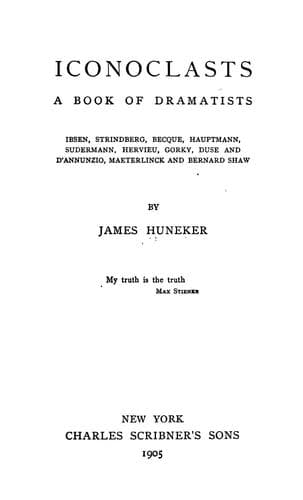
Iconoclasts: A Book of Dramatists: Ibsen, Strindberg, Becque, Hauptmann, Sudermann, Hervieu, Gorky, Duse and D'Annunzio, Maeterlinck and Bernard ShawHuneker, James
History
Iconoclasts: A Book of Dramatists: Ibsen, Strindberg, Becque, Hauptmann, Sudermann, Hervieu, Gorky, Duse and D'Annunzio, Maeterlinck and Bernard Shaw
Huneker, James
Dramatists; European drama -- 19th century -- History and criticism; European drama -- 20th century -- History and criticism
However, with all its crudities, its imitations, its impossible
_mélange_ of blood, lust, tears, terror, there are several elements in
the crazy play that indicate latent gifts of a high order. The range,
is narrow and Poe-like. Fear is the theme, and a strange repetition
the method of expression. There is a young prince, a Hamlet, who has
fed on the art of the modern decadents. He is a spiritual half-brother
to Laforgue's Hamlet, shorn of that ironist's humour. Never could
Prince Hjalmar of the Maeterlinck tragedy utter such a sublimely ironic
soliloquy as Laforgue's, more Shakespearian than Shakespeare.
"Alas! poor Yorick! As one seems to hear, in one little shell, all the
multitudinous roar of the ocean, so I here seem to perceive the whole
quenchless symphony of the universal soul, of whose echoes this box was
as the cross-roads. And do you imagine a human race that would look
no farther, that would abide by this vaguely, immortal sound, which
one hears in a hollow skull, by way of explanation of death, by way of
religion?... They also had their time, all these small folk of history;
learning to read, paring their nails, illuminating the unsavoury
lamp, loving every night, gormandizing, vain, crazy for compliments,
kisses.... But yet--no longer to be, no longer to be in it, no longer
to be of it! Not even to be able to strain against one's human heart,
any afternoon in the week, the melancholy of centuries compressed into
one little chord upon the piano!..."
Maeterlinck's hero, too, is oppressed by the mystery of life.
Throughout the drama the Fate of ancient tragedy marches remorselessly
through the doomed palace of the king. Thanks to Maeterlinck, this
Fate takes on a new countenance. A disquieting attack is made upon the
nerves by the repercussive repetitions, the dense pall of melancholy
hanging over the place. A madhouse is a cheerful place by comparison.
One king has slain another and made a beggar outcast of the Princess
royal, Maleine. She is loved by and loves Prince Hjalmar--an odd
transposition of the sunny passions of Romeo and Juliet. The beggar
girl becomes maid in the palace of her father's murderer. It is not a
happy habitation. The old King is senile and debauched by Anne, Queen
of Jutland. This mis-creant, a hideous combination of Lady Macbeth,
Messaline, and Phædra, has a daughter bearing the pretty name of
Uglyane. Poor Uglyane! She is beautiful, unloved. The one assignation
of her life is defeated by Maleine, who plays a cruel trick upon her.
Going to the fountain--later we shall find that fountains assume
important rôles in these plays--Maleine meets Hjalmar. Then we get the
true Maeterlinck atmosphere. And this is where it may come from:--
Public-domain text, read in full here on John Shaqi.
Reviews
Reviews
No reviews yet
Be the first to share your thoughts on this work.
Elsewhere in the archive
Join the Discussion
Join the discussion
Sign in to leave a comment or review.
Sign InorCreate an account