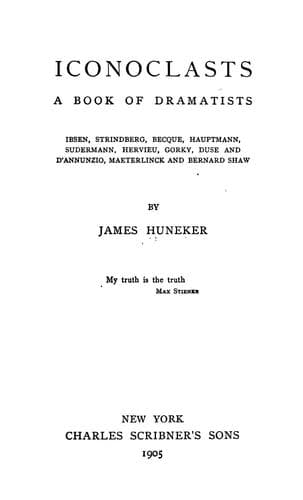
Iconoclasts: A Book of Dramatists: Ibsen, Strindberg, Becque, Hauptmann, Sudermann, Hervieu, Gorky, Duse and D'Annunzio, Maeterlinck and Bernard ShawHuneker, James
History
Iconoclasts: A Book of Dramatists: Ibsen, Strindberg, Becque, Hauptmann, Sudermann, Hervieu, Gorky, Duse and D'Annunzio, Maeterlinck and Bernard Shaw
Huneker, James
Dramatists; European drama -- 19th century -- History and criticism; European drama -- 20th century -- History and criticism
I looked upon the scene before me--upon the mere house
and the simple landscape features of the domain, upon the
bleak walls, upon the vacant, eye-like windows, upon a
few rank sedges, and upon a few white trunks of decayed
trees.... I reined my horse to the precipitous brink of a
black and lurid tarn that lay in unruffled lustre by the
dwelling and gazed down.... About the whole mansion and
domain there hung an atmosphere peculiar to themselves
and their immediate vicinity; an atmosphere which had no
affinity with the air of heaven, but which had reeked up
from the decayed trees, and the gray wall, and the silent
tarn; a pestilent and mystic vapour, dull, sluggish,
faintly discernible, and leaden-hued.
Pestilent and mystic is the atmosphere of Princess Maleine. The
quotation is from The Fall of the House of Usher. There is much of
Poe's dark tarn, of Auber, and the misty mid-region of Weir in the
early Maeterlinck.
The dénouement is horrible. Maleine is strangled by the Queen, who
also loves Hjalmar, and to the accompaniment of a lunar eclipse,
thunderbolts, a cyclone, meteors that explode, wounded swans that fall
from stormy skies, this night of strange portents comes to an end after
the prince avenges Maleine by stabbing the queen and killing himself.
There is a dog that sniffs, scratches, and howls at the locked door
of the murdered princess. Its name is Pluto. There are chanting and
spectral nuns, lewd beggars, an old Shakespearian nurse, a freakish
boy, and the usual scared courtiers. The scenes do not hang together
at all--there is no sequence of action, only of moods; or rather the
same mood persists throughout. Yet the lines bite at times, and there
are great fissures of silence, pauses as deep and as sinister as murky
midnight pools.
These pauses are always pregnant,--like the pauses in strange pages of
Schumann or those mysterious empty bars at the beginning of a Chopin
tragedy in tone,--empty, forbidding vestibules to woful edifices.
"There is a little kitchen maid's soul at the bottom of her green
eyes;" "I am sick to die of it one of those twenty thousand nights we
have to live;" "How dark? how dark? Is a forest lit up like a ball
room?" "The poor never know anything;" "Will she not have a little
silence in her heart?" "She is as cold as an earthworm;" "Oh! look,
look at their eyes. They will leap out upon me like frogs;" "My God!
My God! She is waiting now on the wharves of hell;" "How unhappy the
dead look!" These and many more, with gasps and ejaculations, make up a
dialogue that is at least original, though bizarre. Naturally it is all
the fruit of green, immature genius.
The ideas, hysterical and few as they are, begin to assume some
coherence if compared with the emotional and disconnected experiments
of the poems.
Public-domain text, read in full here on John Shaqi.
Reviews
Reviews
No reviews yet
Be the first to share your thoughts on this work.
Elsewhere in the archive
Join the Discussion
Join the discussion
Sign in to leave a comment or review.
Sign InorCreate an account