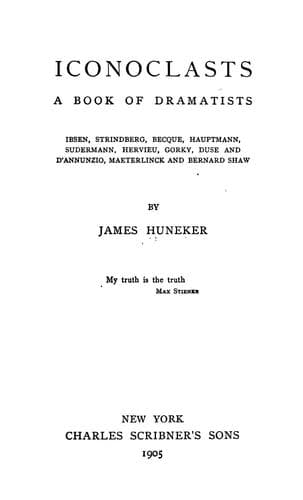
Iconoclasts: A Book of Dramatists: Ibsen, Strindberg, Becque, Hauptmann, Sudermann, Hervieu, Gorky, Duse and D'Annunzio, Maeterlinck and Bernard ShawHuneker, James
History
Iconoclasts: A Book of Dramatists: Ibsen, Strindberg, Becque, Hauptmann, Sudermann, Hervieu, Gorky, Duse and D'Annunzio, Maeterlinck and Bernard Shaw
Huneker, James
Dramatists; European drama -- 19th century -- History and criticism; European drama -- 20th century -- History and criticism
Maeterlinck has defined his æsthetic in his prose essays. He played
queer pranks upon the nerves with these shadows, these spiritual
marionettes, which are pure abstractions typifying various qualities
of the temperament. The iteration of his speech is like the dripping
of water upon the heads of the condemned. It finally stuns the
consciousness, and then, like a performer upon some fantastic
instrument with one string, this virtuoso executes variations boasting
a solitary theme--the fear of Fear.
Speech, says Maeterlinck, is never the medium of communication of real
and inmost thoughts. Silence alone can transmit them from soul to soul.
We talk to fill up the blanks of life. Silence is so truth-telling,
so illuminative, that few have the courage to face it. Mankind fears
silence more than the dark. (Poe again; Silence.) The most illuminating
silence of all, the most irresistible, is the Silence of Death. It is
the unspoken word that reveals our inner self. "We do not know each
other; we have not yet dared to be silent together." Modern thought
and literature lack this mystic element, lack the atmosphere of the
spiritual, perfect as is its technic and its intellectual equipment.
The Russians have it in their fiction--a fiction of epilepsy and
burning spiritual crises. The Middle Ages had it. Men stood nearer
to nature, to God. They understood children, women, animals, plants,
inanimate objects, with greater tenderness and greater depth. "The
statues and paintings they have left us may not be perfect, but a
mysterious power and secret charm that I cannot define are imprisoned
within them, and bestow upon them perpetual youth. Hamlet, King Lear,
Macbeth, are filled with the mysterious chant of the infinite, the
threatening silence of souls and of gods, eternity thundering on the
horizon, fate and fatality perceived interiorly without any one being
able to say by what signs they have been recognized."
Here we recognize the true mystic, the feeder upon the writings of
Emerson, Novalis, the Admirable Ruysbroeck; Plato, Plotinus, St.
Bernard, Jacob Boehme, and Coleridge. And while he achieves astonishing
flights into the blue, he always returns to mother earth. There
is spiritual lift in his words,--lift and ofttimes intoxication.
Generations of Flemish ancestors have dowered this young thinker with
solid nerves and a saner intellectual apparatus than his early critics
imagined. And he never exhibits what old Chaucer called "the spiced
conscience." Neither hell's flames nor the joys of heaven appear in his
pages. He preaches only of man and the soul of man.
Public-domain text, read in full here on John Shaqi.
Reviews
Reviews
No reviews yet
Be the first to share your thoughts on this work.
Elsewhere in the archive
Join the Discussion
Join the discussion
Sign in to leave a comment or review.
Sign InorCreate an account