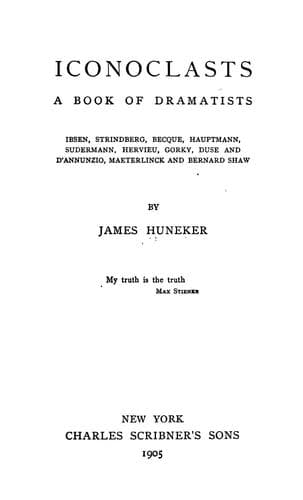
Iconoclasts: A Book of Dramatists: Ibsen, Strindberg, Becque, Hauptmann, Sudermann, Hervieu, Gorky, Duse and D'Annunzio, Maeterlinck and Bernard ShawHuneker, James
History
Iconoclasts: A Book of Dramatists: Ibsen, Strindberg, Becque, Hauptmann, Sudermann, Hervieu, Gorky, Duse and D'Annunzio, Maeterlinck and Bernard Shaw
Huneker, James
Dramatists; European drama -- 19th century -- History and criticism; European drama -- 20th century -- History and criticism
Without the mystery of life, life is not worth the living. The static
opposed to the dynamic theatre is his ideal mood, not action; the
immaterial, not the obvious. Hamlet is not awake--at every moment
does he advance to the very brink of awakening. The mysterious chant
of the Infinite, the ominous silence of the soul and of God, the
murmur of Eternity on the horizon, the destiny or fatality that we are
conscious within us, though by what tokens none may tell--do not all
these underlie King Lear, Macbeth, Hamlet? Are there not elements of
deeper gravity and stability in happiness in a single moment of repose
than in the whirlwind of passion? Does the soul only flower on nights
of storm? "But to the tragic author, as to the mediocre painter who
still lingers over historical pictures, it is only the violence of
the anecdote that appeals ... whereas it is far away from bloodshed,
battle-cry, and sword thrust that the lives of most of us flow on, and
men's tears are silent to-day, and invisible, and almost spiritual."
Maeterlinck goes to the modern theatre and feels as if he had spent
a few hours with his ancestors, who conceived life as something that
was primitive, arid, and brutal. He sees murder, hears of deceived
husbands and wives instead of being shown some act of life "traced
back to its sources and to its mystery by connecting links." He yearns
for one of the strange moments of a higher life that flit unperceived
through his dreariest hours. "Othello does not appear to live the
august daily life of Hamlet, who has the time to live, inasmuch as he
does not act. Othello is admirably jealous. But is it not perhaps an
ancient error to imagine that it is at the moment when this passion,
or others of equal violence, possess us that we live our truest lives?
I have grown to believe that an old man, seated in his arm-chair,
waiting patiently with his lamp beside him; giving unconscious ear to
all the eternal laws that reign about the house, interpreting, without
comprehending, the silence of doors and windows and the quivering voice
of light, submitting with bent head to the presence of his soul and
his destiny--an old man, who conceives not that all the powers of this
world, like so many heedful servants, are mingling and keeping vigil
in his room, who suspects not that the very sun is supporting in space
the little table against which he leans or that every star in heaven
and every fibre of the soul are directly concerned in the movement
of an eyelid that closes, or a thought that springs to birth--I have
grown to believe that he, motionless as he is, does yet live in reality
a deeper, more human, and more universal life than the lover who
strangles his mistress, the captain who conquers in battle, or the
husband who avenges his honour."
Public-domain text, read in full here on John Shaqi.
Reviews
Reviews
No reviews yet
Be the first to share your thoughts on this work.
Elsewhere in the archive
Join the Discussion
Join the discussion
Sign in to leave a comment or review.
Sign InorCreate an account