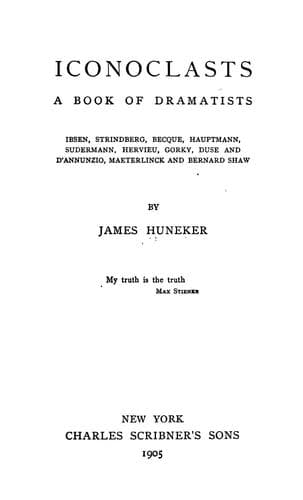
Iconoclasts: A Book of Dramatists: Ibsen, Strindberg, Becque, Hauptmann, Sudermann, Hervieu, Gorky, Duse and D'Annunzio, Maeterlinck and Bernard ShawHuneker, James
History
Iconoclasts: A Book of Dramatists: Ibsen, Strindberg, Becque, Hauptmann, Sudermann, Hervieu, Gorky, Duse and D'Annunzio, Maeterlinck and Bernard Shaw
Huneker, James
Dramatists; European drama -- 19th century -- History and criticism; European drama -- 20th century -- History and criticism
This excerpt (translated by Alfred Sutro) shows the real Maeterlinck,
the man whose mind is imbued by the strangeness of common life, the
mystic correspondences, the star in the grain of wheat. The philosophy
is akin to certain passages executed in the allegoric pictures of
Albrecht Dürer, William Blake, Rossetti, and Burne-Jones.
Each century, he argues, has its own near sorrow. It is well that we
should sally forth in search of our sorrows--the value of ourselves is
but the value of our melancholy and disquiets. The tragic masterpieces
of the past are inferior in the quality of their sorrow compared to
the sorrows of to-day. To-day it is fatality that we challenge; and
this is perhaps the distinguishing note of the new theatre. It is
no longer the effects of disaster that arrest our attention; it is
disaster itself; and we are eager to know its essence and its laws. It
is the rallying point of the most recent dramas, the centre of light
with strange flames gleaming, about which revolve the souls of women
and men. And a step has been taken toward the mystery so that life's
mysteries may be looked in the face. Between past and future man ("What
is man but a god who is afraid?") stands trembling on the tiny oasis of
the present. It is the disaster of our existence that we fear our soul;
did we but allow it to smile frankly in its silence and its radiance,
we should be already living an eternal life. O for those "reservoirs
of certitudes" on the other side of night, "whither the silent herd of
souls flock every morning to slake their thirst."
"To every man there come noble thoughts that pass his heart like great
white birds." Then is recalled Browning and his similitude of the
meanest soul that has its better side to show its love. "In life there
is no creature so degraded but knows full well which is the noble and
beautiful thing he must do." A life perceived is a life transformed.
To love one's self is to love thy neighbour in thyself! Maeterlinck's
attitude toward woman--the true touchstone of philosopher, poet,
priest, and artist--is beautiful. "I have never met a single woman who
did not bring to me something that was great."
Public-domain text, read in full here on John Shaqi.
Reviews
Reviews
No reviews yet
Be the first to share your thoughts on this work.
Elsewhere in the archive
Join the Discussion
Join the discussion
Sign in to leave a comment or review.
Sign InorCreate an account