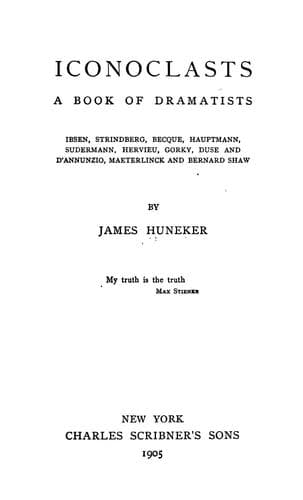
Iconoclasts: A Book of Dramatists: Ibsen, Strindberg, Becque, Hauptmann, Sudermann, Hervieu, Gorky, Duse and D'Annunzio, Maeterlinck and Bernard ShawHuneker, James
History
Iconoclasts: A Book of Dramatists: Ibsen, Strindberg, Becque, Hauptmann, Sudermann, Hervieu, Gorky, Duse and D'Annunzio, Maeterlinck and Bernard Shaw
Huneker, James
Dramatists; European drama -- 19th century -- History and criticism; European drama -- 20th century -- History and criticism
The spiritual renascence may be at hand. It is the theatre that last
feels its approach. Poetry, painting, sculpture, music, all have met
it halfway; only the stage lags in the rear. Plot, action, trickeries,
cheap illusions, must be swept away into the limbo of things used up.
Atmosphere, the atmosphere of unuttered emotions, arrested attitudes,
ideas of the spiritual subconscious, are to usurp the mechanical
formulas of to-day. The ideal is music--music, the archetype of the
arts. (Walter Pater preached this platonic doctrine.) "It is only
the words that at first sight seem useless that really count in a
work." But to realize, to exteriorize the mystery, the significance of
the soul life, what a strange and symbolic web must be woven by the
poet-dramatist! He must break with the conventions of the past and
create something that is not quite painting, not quite drama, something
that is more than poetry, less than music--full of ecstasies, silent
joys, luminous pauses, and the burning fever of the soul that sometimes
slays.
It is very beautiful, very ideal--bard, poet, mystic, moralist, and
playwright, that Maeterlinck dared to become. He practised _before_ he
preached--unlike most men; and he had the slow fortitude of the brave.
We know now that artistically he springs from the loins of Poe and
Hoffmann; that Villiers de l'Isle Adam was his spiritual godfather;
that by the Belgian's artful scale of words he evoked images in our
mind which recall the harmonies of unheard music; that the union of
mysticism and freedom of thinking lends to his work peculiar eloquence;
that his device is "Within me there is more," a mediæval inscription
borrowed from an old doorway in Bruges. He is more revolutionary than
Ibsen in the matter of technic. Maeterlinck writes a play about an
open door, a closed window, or the vague and disheartening twilights
of cloudy gardens. That he is quite sane in his early work we must not
assert--since when shall art and sanity be driven in easy harness?
In giving a bare abstract of Maeterlinck's theories, spiritual and
æsthetic, their beauty and nobility, we but clear the way for a better,
because wider, appreciation of the plays. Let us consider them all from
The Intruder to Monna Vanna and Joyzelle.
II
"By mysticism we mean, not the extravagance of an erring fancy, but the
concentration of reason in feeling, the enthusiastic love of the good,
the true, the one, the sense of the infinity of knowledge, and of the
marvel of the human faculties. When feeding upon such thoughts the
'wing of the soul is renewed and gains strength, she is raised above
the manikins of earth' and their opinions, waiting in wonder to know
and working with reverence to find out what God in this or in another
life may reveal to her."
Public-domain text, read in full here on John Shaqi.
Reviews
Reviews
No reviews yet
Be the first to share your thoughts on this work.
Elsewhere in the archive
Join the Discussion
Join the discussion
Sign in to leave a comment or review.
Sign InorCreate an account