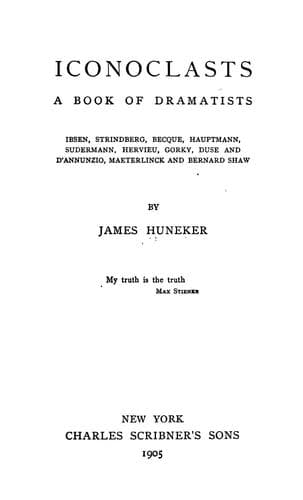
Iconoclasts: A Book of Dramatists: Ibsen, Strindberg, Becque, Hauptmann, Sudermann, Hervieu, Gorky, Duse and D'Annunzio, Maeterlinck and Bernard ShawHuneker, James
History
Iconoclasts: A Book of Dramatists: Ibsen, Strindberg, Becque, Hauptmann, Sudermann, Hervieu, Gorky, Duse and D'Annunzio, Maeterlinck and Bernard Shaw
Huneker, James
Dramatists; European drama -- 19th century -- History and criticism; European drama -- 20th century -- History and criticism
This is not from Maurice Maeterlinck; it was written by a hard-headed
man and lovable teacher, the late Benjamin Jowett, the famous Master
of Balliol. Not intended as a text, but merely to show that the lift
of spirit, which is the sign manual of mysticism, does not prelude the
practical. It is a fresh visual angle from which are viewed the things
of heaven and earthly things.
In his youth, possibly to escape the sterilities of the code--for he
was an advocate by profession---Maeterlinck took up the mystic writers
though the drama pulled him hard, as it ever does with the preëlected.
Little danger of this ardent young man weighing, as do many, the
theatre in the scales of commerce. As with Ibsen, the stage was an
escape for Maeterlinck; it liberated ideas, poetic, dramatic, mystic,
which had become intolerable, ideas which turned his brain. That art
of which Pinero so eloquently writes, "The great, the fascinating,
and most difficult art,... compression of life without falsification,"
could never have signified a gold mine for Maeterlinck as it did for
Robert Louis Stevenson. To the Belgian it was not a speculation, but
a consecration. To it he brought that "concentration of thought and
sustained intensity" which Pinero deems imperative in the curriculum
of a dramatic artist.
Upon the anvil of his youthful dreams did Maeterlinck forge his little
plays for marionettes. Shadowy they are, brief transcripts of emotion,
but valuable in illustrating unity of purpose, of mood, of _tone_.
Herein lies their superiority to Browning's more elaborate structures.
Before he ventured into the maze of plotting, Maeterlinck was content
with simple types of construction. The lyric musician in this poet,
the lover of beauty, led him to make his formula a musical one. The
dialogue of the first plays seems like new species of musical notation.
If there is not rhyme there is rhythm, interior rhythm, and an alluring
assonance. Hence we get pages burdened with repetitions and also the
"crossing fire" of jewelled words. Apart from their spirit the lines of
this poet are sonorously beautiful. In the "purple" mists of his early
manner a weaker man might have perished. Not so Maeterlinck. He is
first the thinker--a thinker of strange thoughts independent of their
verbal settings. He soon escaped preciosity in diction; it was monotony
of mood that chained him to his many experimentings.
Public-domain text, read in full here on John Shaqi.
Reviews
Reviews
No reviews yet
Be the first to share your thoughts on this work.
Elsewhere in the archive
Join the Discussion
Join the discussion
Sign in to leave a comment or review.
Sign InorCreate an account