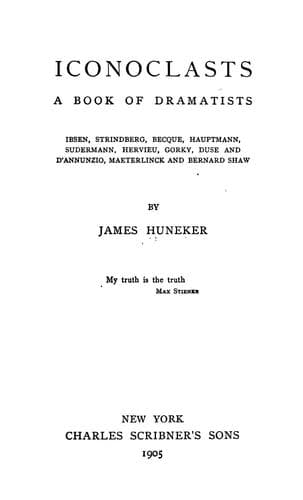
Iconoclasts: A Book of Dramatists: Ibsen, Strindberg, Becque, Hauptmann, Sudermann, Hervieu, Gorky, Duse and D'Annunzio, Maeterlinck and Bernard ShawHuneker, James
History
Iconoclasts: A Book of Dramatists: Ibsen, Strindberg, Becque, Hauptmann, Sudermann, Hervieu, Gorky, Duse and D'Annunzio, Maeterlinck and Bernard Shaw
Huneker, James
Dramatists; European drama -- 19th century -- History and criticism; European drama -- 20th century -- History and criticism
And therein the old ghost of the Romantics comes to life asserting its
"claims of the ideal," as Ibsen has the phrase. Crushed to dust by the
hammers of the realists, sneered at in the bitter-sweet epigrams of
Heine, Romance returns to us wearing a new mask. We name this mask
Symbolism; but joyous, incarnate behind its shifting shapes, marches
Romance, the Romance of 1830, the Romance of--Before the Deluge.
The earth-men, the Troglodytes, who went delving into moral sewers
and backyards of humanity, ruled for a decade and a day; then the
vanquished reconquered. In this cycle of art it is Romance that comes
to us more often, remains longer when it does come.
Maurice Maeterlinck employs the symbol instead of the sword; the psyche
is his _panache._ His puppets are all poetic--the same poetry as of eld
informs their gestures and their speech. He so fashions them of such
fragile pure stuff that a phrase maladministered acts as the thrust
of a dagger. The Idea of Death slays: the blind see; bodies die, but
the soul persists; voices of expiring lovers float through vast and
shadowy corridors--as in Alladine and Palomides--children speak as if
their lips had been touched by the burning coal of prophecy; their
souls are laid bare with a cruel pity; love is strangled by a hair;
we see Death stalk in the interior of a quiet home, or rather _feel_
than see; or in our ears is whispered a terrible and sweet tale of
the Death of Tintagiles--it is all moonlight music, mystery with a
nightmare _finale_; or a tender original soul is crushed by the sheer
impact of a great love hovering near it--Aglavaine and Sélysette. Then
we get fantasy and miracle play, librettos, full of charm, wonder, and
delicious irony. Maeterlinck recalls life, beckons to life, and in
Monna Vanna smashes the stained-glass splendours hemming him in from
the world; and behold--we are given drama, see the shock of character,
and feel the mailed hand of a warrior-dramatist. In a dozen years he
has traversed a kingdom, has grown from _wunderkind_ to mature artist,
from a poet of few moods to a maker of viable drama.
The chronology of the Maeterlinckian dramatic works is this: Princess
Maleine (1889); The Intruder, The Blind (1890); The Seven Princesses
(1891); Pelléas and Mélisande(1892); Alladine and Palomides, Interior,
The Death of Tintagiles (1894); Aglavaine and Sélysette (1896); Ariane
and Barbe-Bleu, Sister Beatrice (1901); Monna Vanna (1902); Joyzelle
(1903).
Though the first attempts are emotional presentations of ideas, though
the dramatic form is, from a Scribe standpoint, amateurish, yet the
unmistakable _flair_ of the born dramatist is present. In the beginning
Maeterlinck elected to mould poetic moods; later on we shall see him a
moulder of men and women.
Public-domain text, read in full here on John Shaqi.
Reviews
Reviews
No reviews yet
Be the first to share your thoughts on this work.
Elsewhere in the archive
Join the Discussion
Join the discussion
Sign in to leave a comment or review.
Sign InorCreate an account