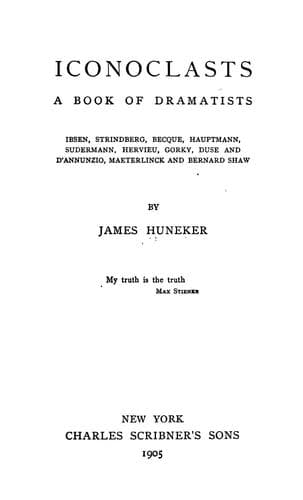
Iconoclasts: A Book of Dramatists: Ibsen, Strindberg, Becque, Hauptmann, Sudermann, Hervieu, Gorky, Duse and D'Annunzio, Maeterlinck and Bernard ShawHuneker, James
History
Iconoclasts: A Book of Dramatists: Ibsen, Strindberg, Becque, Hauptmann, Sudermann, Hervieu, Gorky, Duse and D'Annunzio, Maeterlinck and Bernard Shaw
Huneker, James
Dramatists; European drama -- 19th century -- History and criticism; European drama -- 20th century -- History and criticism
A thinker may view the visible universe as a symbol, as the garment
wherewith the gods conceal themselves; this Goethe did. Or this
globe, upon the round of which move sorrowful creatures whirled
through space from an unthinkable past to an unthinkable future, may
be apprehended as a phantasmagoria, shot through with misery, a cage
of dreams, a prison wherein the echoes of what has been thought and
done meet in cruel confluence within the walls of the human brain.
All pessimistic cosmogonists, poets, dramatists, dwell, with the
obsession of an _idée fixe_, upon this scheme of things terrestrial.
And then there is De Maupassant, an _eye,_ which photographed the
salient profiles of his fellow-beings; or Poe, who, suffering from
an incurable disease, felt the horror of the pulse-beat, the hideous
drama of mere sentience. Charles Darwin, with pitiless objectivity,
displays a map of life whereon the struggle is eternal--a struggle
from protoplasm to Super-Man (the latter a mad idea in a poet's
skull). Carlyle thunders at the Sons of Belial and we shrivel up in
the fiery furnace of his eloquent wrath; or John Henry Newman wooes
us to God with beautiful, gentle speech. To every man his illusion.
Maeterlinck's is the apprehension of the helplessness of mankind,
though not its hopelessness. His optimism, the germ of which is in the
poems, has grown steadily with the years. And the tinge of pessimism,
of morbidity, in his earlier productions has vanished in the dialectic
of his prose.
Maeterlinck first saw his drama as music--this is a contradiction in
terms, but it best expresses the meaning intended. As in music there
are ebb and flow, rhythmic pulse, so his little landscapes unroll
themselves with iteration to the accompaniment of mournful voices.
No dramatist, ancient or modern, so depends upon vocal _timbre_ to
embody his dreams as this one. In reality his characters are voice or
nothing. From the deeps of haunted gardens come these muffled voices,
voices suffocated by sorrow, poignant voices and sinister. Allusion
has been made to the Poe-like machinery of Maeterlinck--atmosphere. It
is, however, only external. He works quite differently from Poe, and
the _dekoration_ with its dreamy forests, skies lowering or resonant
with sunshine, parks and fountains, stretch of sea and dreary moats,
is but a background for his moods. He pushes much farther than Ibsen
and Wagner the rhythmic correspondences of man and his artistic
environment. But the voice dominates his drama, the human voice with
all its varied intonations, its wealth of subtle _nuance_.
Public-domain text, read in full here on John Shaqi.
Reviews
Reviews
No reviews yet
Be the first to share your thoughts on this work.
Elsewhere in the archive
Join the Discussion
Join the discussion
Sign in to leave a comment or review.
Sign InorCreate an account