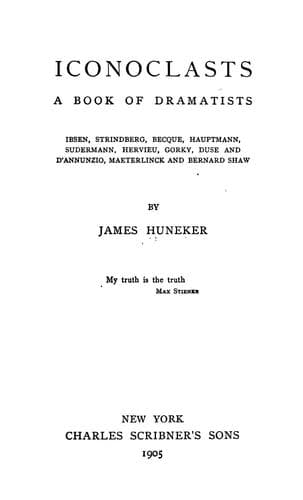
Iconoclasts: A Book of Dramatists: Ibsen, Strindberg, Becque, Hauptmann, Sudermann, Hervieu, Gorky, Duse and D'Annunzio, Maeterlinck and Bernard ShawHuneker, James
History
Iconoclasts: A Book of Dramatists: Ibsen, Strindberg, Becque, Hauptmann, Sudermann, Hervieu, Gorky, Duse and D'Annunzio, Maeterlinck and Bernard Shaw
Huneker, James
Dramatists; European drama -- 19th century -- History and criticism; European drama -- 20th century -- History and criticism
Instead of the idea-complexity we find in Browning, in Maeterlinck the
single motif is elaborated. He is not polyphonic,--to borrow a musical
metaphor,--but monophonie. Where he is a psychologist of the most
modern stamp lies in his perception of the fact that there is no longer
an autonomous _I_, the human ego is an orchestra of collective egos.
_We,_ not _I_, is the burden of our consciousness. Through countless
ages the vast chemistry of the Eternal retort has created a bubble, an
atom, which says _I_ to itself in daylight, when looking in mirrors,
but in the dark when the inutile noise of life is ceased then the _I_
becomes a multitudinous _We_. All the head hums with repercussive
memories of anterior existences. Some call it dreaming; others
nerve-memory; others again--recollection of anterior life.
Other dramatists have hinted this pantheism before Maeterlinck.
Shakespeare was a symbolist; so was Ibsen when he penned his The Master
Builder. But the younger man makes a formula of the idea. His is the
dramaturgy of the subconscious. His people say things and thereby
reveal their multiple personalities, even the colour of their souls.
Here, then, is the symbolist. To put the case more clearly, let Aline
Gorren be heard,--a writer who is imbued with the beauty of symbolic
ideas:--
"Your documents, details, verified facts, are precisely
the least worth considering," says, in effect, the
Symbolist. "They are appearances; impalpable shadows of
clouds. Nothing ye think to see is what it seems." Nothing
outside of our representation exists. All visibilities are
symbols. Our business is to find out what these symbols
are. Any book that does not directly concern itself with
the hints concealed beneath the diversified masks and
aspects of matter is a house built out of a boy's toy
blocks. Science, after promising more things than it could
fulfil, has many hypotheses just now that float about one
central idea--the existence of one essence, infinite in
moods, by reference to which alone anything whatsoever can
be understood. Those of our creed only and solely have a
philosophic basis for their art.
Emil Verhaeren, Belgian mystic, anarchist, poet, sings of The Forest of
Numbers in his hate-saturated chants, Les Flambeaux Noirs.
Je suis l'halluciné de la forêt des Nombres.
Public-domain text, read in full here on John Shaqi.
Reviews
Reviews
No reviews yet
Be the first to share your thoughts on this work.
Elsewhere in the archive
Join the Discussion
Join the discussion
Sign in to leave a comment or review.
Sign InorCreate an account