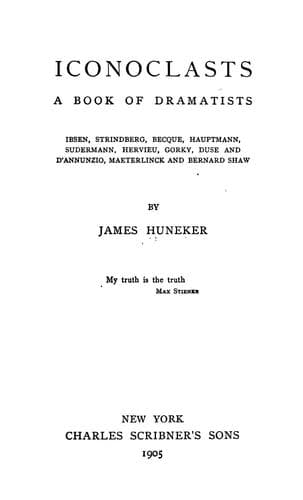
Iconoclasts: A Book of Dramatists: Ibsen, Strindberg, Becque, Hauptmann, Sudermann, Hervieu, Gorky, Duse and D'Annunzio, Maeterlinck and Bernard ShawHuneker, James
History
Iconoclasts: A Book of Dramatists: Ibsen, Strindberg, Becque, Hauptmann, Sudermann, Hervieu, Gorky, Duse and D'Annunzio, Maeterlinck and Bernard Shaw
Huneker, James
Dramatists; European drama -- 19th century -- History and criticism; European drama -- 20th century -- History and criticism
The second act of Pelléas and Mélisande begins at an immemorial
fountain in the royal park. Here the young Prince sits with the
wife of his brother. Mélisande is one of the poet's most successful
full-length portraits. She is exquisitely girlish, is charming with her
strange Undine airs, and is touched by a singular atmosphere of the
remote. Hauptmann has realized the same ethereal type in Rautendelein.
Mélisande is very romantic. At times she is on the point of melting
into the green tapestry of the forest. She is a woodland creature. More
melancholy than Miranda, she is not without traces of her high-bred
temperament; less real than Juliet, she seems quite as passion-smitten.
Not altogether a comprehensible creation, Mélisande piques one at every
reading, with her waywardness, her infantile change of moods.
At the spring the two converse of the water and its healing powers
--"You would say that my hands were sick to-day," she murmurs as she dips
her hand into the pool. She loses her wedding ring. The conversation is
all as indirect, as elliptical, as Robert Browning or Henry James. Let
it be said that the affectation of understanding Browning at all points
is not so banal as the pretence of _not_ understanding Maeterlinck. The
symbol floats like a flag in his dramas.
In the interim Golaud has been wounded while hunting. It is not
serious, but it unlooses the heart of Mélisande, who confesses that
she, too, is ill. With her habitual avoidance of the definite, she
does not, or will not, tell her husband the cause of her vague unrest
and spiritual nostalgia. The interview is affecting. Golaud, the
middle-aged, cannot overhear the shell-like murmurings of this baby
soul. She recounts the loss of her wedding ring, but prevaricates.
Golaud bids her go search for it in company with Pelléas--always
Pelléas. In a grotto the two again meet. The cave is full of "blue
darks," and outside the moon has "torn through a great cloud." Suddenly
three sleeping beggars are discovered (again a recurrence to the
earlier style). They mean something, of course, though they do not
awaken. In certain pages of Maeterlinck it is well to let sleeping
symbols lie undisturbed. The action now moves apace. Pelléas, fearing
danger, wishes to fly, but is dissuaded by his grandfather.
In Act III Pelléas and Mélisande sit and converse. Little Yniold, with
his curious child's brain and child's candour, really discovers to the
lovers their mutual love. It is done captivatingly.
Public-domain text, read in full here on John Shaqi.
Reviews
Reviews
No reviews yet
Be the first to share your thoughts on this work.
Elsewhere in the archive
Join the Discussion
Join the discussion
Sign in to leave a comment or review.
Sign InorCreate an account