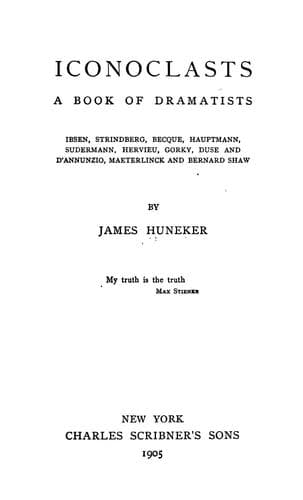
Iconoclasts: A Book of Dramatists: Ibsen, Strindberg, Becque, Hauptmann, Sudermann, Hervieu, Gorky, Duse and D'Annunzio, Maeterlinck and Bernard ShawHuneker, James
History
Iconoclasts: A Book of Dramatists: Ibsen, Strindberg, Becque, Hauptmann, Sudermann, Hervieu, Gorky, Duse and D'Annunzio, Maeterlinck and Bernard Shaw
Huneker, James
Dramatists; European drama -- 19th century -- History and criticism; European drama -- 20th century -- History and criticism
"You have been weeping, little mother," he says to his mother, in his
father's presence. "Do not hold the lamp under their eyes so," responds
Golaud. Then follows the poetic and famous scene of Mélisande on the
tower combing her unbound locks and singing in the moonlight. It is a
magical picture. One recalls Lilith, that first wife of Adam, painted
by Rossetti, who also combed dangerous silken tresses. Pelléas enters,
and the ensuing duologue is rich in tenderness and amorous poetry. One
in vain endeavours to recall so intensely vivid a scene in literature
since Romeo and Juliet. The romance of the French Romantics always
verged on the melodramatic and artificial, and the stately classics
are not happy in moments of this kind. The similar scene in Cyrano,
when compared to Pelléas and Mélisande, is mere rococo pasteboard,
though theatrically effective. Rostand is, at his best, Orientally
sentimental, as befits his blood; he is never truly poetic, for he is a
winning rhetorician, a "rhyming Sardou," rather than a dramatic poet.
The mad apostrophe to the hair of Mélisande is in key with the entire
setting of this moving tableau. "I have never seen such hair as thine,
Mélisande. I see the sky no longer through thy locks.... They are
alive like birds in my hands." Even the surprising of the lovers by
the sleepless husband has nothing theatric in it. He tells them that
they are children--"what children!"--and bids Mélisande not to lean
so far out of her window. In the next scene we see him with Pelléas
in the vaults of the castle. There is something evil in his heart; in
the brain of Maeterlinck there was Poe when he wrote this episode.
Golaud leads Pelléas through the vault. Pelléas almost stumbles into
an abyss--his brother has made a misstep. We feel ourselves listening
here on the brink of a catastrophe that does not happen. It recalls
Poe's Cask of Amontillado.
A painful scene is the questioning of little Yniold by his father. He
asked the boy what Mélisande and Pelléas talked of when together; asked
of their movements. Then he lifts his son to the window and bids him
look on and report. It is masterly in its cruel directness. "Are they
near each other?" he demands. "No, little father." Other even more
searching questions follow, and when the unfortunate spy is clutched
in a fierce grip he cries, "Ah, ah! little father, you have hurt me."
Unconsciously Golaud has betrayed his woful agitation.
Public-domain text, read in full here on John Shaqi.
Reviews
Reviews
No reviews yet
Be the first to share your thoughts on this work.
Elsewhere in the archive
Join the Discussion
Join the discussion
Sign in to leave a comment or review.
Sign InorCreate an account