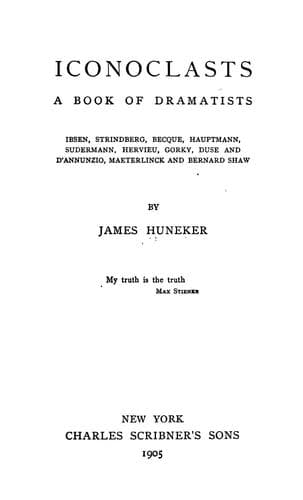
Iconoclasts: A Book of Dramatists: Ibsen, Strindberg, Becque, Hauptmann, Sudermann, Hervieu, Gorky, Duse and D'Annunzio, Maeterlinck and Bernard ShawHuneker, James
History
Iconoclasts: A Book of Dramatists: Ibsen, Strindberg, Becque, Hauptmann, Sudermann, Hervieu, Gorky, Duse and D'Annunzio, Maeterlinck and Bernard Shaw
Huneker, James
Dramatists; European drama -- 19th century -- History and criticism; European drama -- 20th century -- History and criticism
Mélisande is pitied by Arkël. She replies that she is not unhappy.
He responds, "Perhaps you are of those who are unhappy without
knowing it." Golaud enters and reproaches her, seizes her hair. Her
consternation is great. She gives vent to that sentence which in
England convulsed a matter-of-fact audience. "I am not happy. I am not
happy!" The foredoomed lovers meet in the park. It is the great scene
of the piece. Again one must go to Tristan and Isolde, for the lyric
passion has the quality of intense music; that Tristan and Pelléas, of
which Jean Marnold wrote so acutely in the _Mercure de France_:--
Tristan est l'œuvre maîtresse du musicien Wagner. C'est
le défi de son génie au temps. Il eût pu disparaître
après sans craindre l'oubli ou diminuer sa gloire. Mais
ce type idéal du drame wagnérien, de l'aveu même du
réformateur, ce modèle de l'œuvre d'art de l'avenir
apparaît quasiment impossible au théâtre. S'il y assomme
les dévots de l'opéra conventionnel, son poème ahurit,
lasse ou blesse les réceptivités plus exigeantes. Nous
savons, depuis Pelléas, que la vraie vie n'est pas
forcément incompatible avec la scène lyrique; qu'un drame
poignant y peut s'enrober de quelque symbole et s'atourner
de romantisme, sans cesser d'être humain. Nous y vîmes une
action simple emplir une soirée sans chevilles, des amants
s'énoncer sans boursouflure, s'aimer sans philtre et sans
charades, et mourir sans grandiloquence. Le pathos de
Tristan vient trop tard; si tard, qu'il semble aujourd'hui
à sa place adéquate en notre Opéra toulousain.
What Claude Debussy has done with this meeting in his music drama Paris
knows. Speech here in its rhapsodic rush becomes music. And it is all
poetic drama of the loftiest character, dealing with material as old as
Eve. The husband enters, slays his brother, and the curtain falls on
Mélisande fleeing, pursued by Golaud, sword in hand.
The fifth act of this play with its depiction of agony in the
stern soul of Golaud, its death of Mélisande, who dies of a broken
heart, is the tragedy of souls distraught. Even on cold paper it is
emotion-breeding. Arkël, as the spokesman for Fate, bids his son not to
trouble the last moments of Mélisande. She has given birth to a tiny
image of herself, and, quite frightened by the world she has lived
in, she leaves it like a bird scared to sudden flight. She has loved,
though it is not with the "guilty" love her husband supposed. He hovers
over her couch, awaiting the words that will satisfy his egotistic
passion.
"She must not be disturbed," urges the venerable Arkël. "The human soul
is very silent.... The human soul likes to depart alone.... It suffers
so timorously.... But the sadness, Golaud.... The sadness of all we
see.... 'Twas a little being, so quiet, so fearful, and so silent.
'Twas a poor little mysterious being like everybody." ...
Public-domain text, read in full here on John Shaqi.
Reviews
Reviews
No reviews yet
Be the first to share your thoughts on this work.
Elsewhere in the archive
Join the Discussion
Join the discussion
Sign in to leave a comment or review.
Sign InorCreate an account