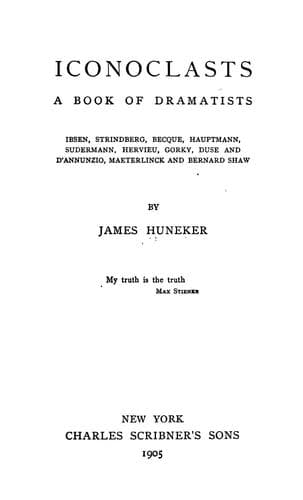
Iconoclasts: A Book of Dramatists: Ibsen, Strindberg, Becque, Hauptmann, Sudermann, Hervieu, Gorky, Duse and D'Annunzio, Maeterlinck and Bernard ShawHuneker, James
History
Iconoclasts: A Book of Dramatists: Ibsen, Strindberg, Becque, Hauptmann, Sudermann, Hervieu, Gorky, Duse and D'Annunzio, Maeterlinck and Bernard Shaw
Huneker, James
Dramatists; European drama -- 19th century -- History and criticism; European drama -- 20th century -- History and criticism
Aglavaine and Sélysette is more shadowy in its treatment than Pelléas
and Mélisande, and no doubt to the lovers of the "precious" in
Maeterlinck more interesting than Monna Vanna. It deals with the love
of two women, Aglavaine and Sélysette, for Méléandre. The delicacy of
technic displayed is almost inconceivable, and the note of irony, faint
as it is, enters a new element in this spiritual duel. To be brief,
Aglavaine is the mouthpiece for Maeterlinck in his Treasure of the
Humble. She is an _esprit fort_, who attracts the husband of Sélysette
by her beauty of soul, vigour of brain, and temperamental intensity.
Poor Sélysette is crushed between the upper and nether millstone of the
man and woman. They both love her devotedly, but being of the Mélisande
type, in her sweet, submissive nature, she fades away until death,
self-sought, comes. She has a fragrant soul, and its fragrance exhales
itself on her deathbed. The dynamics of love prove too much for this
creature. There is tragic pathos in her taking off, and Maeterlinck
is at his best in delineating the tower, with its crumbling walls, the
wheeling birds frightened by the apparition of a falling body, and the
terror and alarm of the little sister. Less, much less, fitted for
theatrical representation than Pelléas and Mélisande, this drama is
charged with symbolism and with rather too severe strain for its poetic
build--too much intellectual freightage. It was composed after the
essays, and it is because of this, perhaps, that I find Aglavaine just
a trifle _doctrinaire._ There is wise and charming talk, the action
_nil._ We get instead _états d'âmes_. The two women expand before
our eyes; it is a rare spiritual growth, psychology in the veritable
sense of that overworked word. Yet the friendship of Aglavaine slays
Sélysette. There is mystery, beauty, of a high order in the play, and
in some things it betrays a distinct advance upon its predecessors.
Sister Beatrice and Ardiane and Barbe Bleu are librettos for music. The
first is a delightful setting of that old Dutch legend made familiar
to English readers by John Davidson in his The Ballad of a Nun. There
are homely pathos and mystic exaltation in Maeterlinck's interpretation
of this nun, who left her convent for the love of man, only to return,
decades later, wrecked in body and soul. But her absence has not been
missed, for the Virgin Mary has stepped down from her niche in the hall
and played the rôle of porteress disguised as the runaway.
Public-domain text, read in full here on John Shaqi.
Reviews
Reviews
No reviews yet
Be the first to share your thoughts on this work.
Elsewhere in the archive
Join the Discussion
Join the discussion
Sign in to leave a comment or review.
Sign InorCreate an account