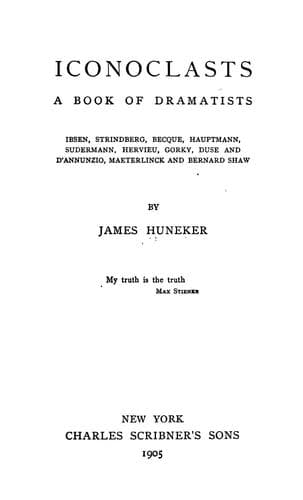
Iconoclasts: A Book of Dramatists: Ibsen, Strindberg, Becque, Hauptmann, Sudermann, Hervieu, Gorky, Duse and D'Annunzio, Maeterlinck and Bernard ShawHuneker, James
History
Iconoclasts: A Book of Dramatists: Ibsen, Strindberg, Becque, Hauptmann, Sudermann, Hervieu, Gorky, Duse and D'Annunzio, Maeterlinck and Bernard Shaw
Huneker, James
Dramatists; European drama -- 19th century -- History and criticism; European drama -- 20th century -- History and criticism
Ardiane married Bluebeard and falls, like the rest of his wives, into
the trap set for them. She defies the monster, and with the help of
the peasants rescues them all from the marvellous dungeons under
the castle. But she goes forth into the world alone--oh, irony of
ironies!--the others do not care to be rescued. The story is told with
charm and brilliancy. The author discovers himself as a _conteur_ with
a light, graceful, humorous touch. It is an ideal libretto--for an
ideal composer. The Miracle of Saint Antony is a comedy which was first
seen at Brussels, October, 1903. It is a "satire of bourgeois society,"
and was well received.
V
Monna Vanna was produced at the Nouveau Théâtre, Paris, May 17, 1902.
In the cast were Georgette Leblanc, Jean Froment, Darmont, Lugné-Poé,
and others. The drama had an immediate success and has been played over
the continent. In London, which will stand any amount of coarseness,
so it be forthright and brutal, a public performance was forbidden to
Monna Vanna.
The action of this sombre, fascinating drama is laid at Pisa near the
close of the fifteenth century. The city is beleaguered by the army of
Prinzevalle sent from Florence. Within, the city has made desperate but
ineffectual resistance; ammunition and food have given out.
A few hours and the city will be in the hands of the enemy, will be
subject to sack, rapine, slaughter. Guido Colonna is at his wits' ends.
In the first act we find him in consultation with his lieutenants. His
father, Marco Colonna, scholar, virtuoso, and philosopher, has been
sent to the camp of Prinzevalle. Thence he returns, and in a scene of
power and suspense he informs his son of the terms set forth by the
conqueror. There is but one way out of the trouble. With rage, horror,
incredulity, Guido Colonna hears that if his wife, the high-born
beauty, Giovanna (Monna Vanna), goes to the tent of the barbarian
captain, Prinzevalle, the siege will be terminated.
His Vanna? Why? Who is this demon out of the nethermost hell that
can formulate such a vile condition? The father calmly explains.
Prinzevalle is not a barbarian, but a Hercules in strength and beauty.
He is cultivated. He has never seen Vanna. He desires the unknown. He
has the thirst for the infinite which characterizes great dreamers,
poets, generals, madmen of the ideal. If Monna Vanna is sent to his
tent, a living sacrifice, in return he will give bread, meat, wine,
gunpowder, arms, to the starving, vanquished city. Guido laughs at
such an insane offer. Marco tells him that the city council knows of
it--that--yes, Vanna has heard it. She is at that moment coming to
speak to her husband. He is stupefied to learn that the council has
spurned the offer. But Vanna has to be counted with.
Public-domain text, read in full here on John Shaqi.
Reviews
Reviews
No reviews yet
Be the first to share your thoughts on this work.
Elsewhere in the archive
Join the Discussion
Join the discussion
Sign in to leave a comment or review.
Sign InorCreate an account