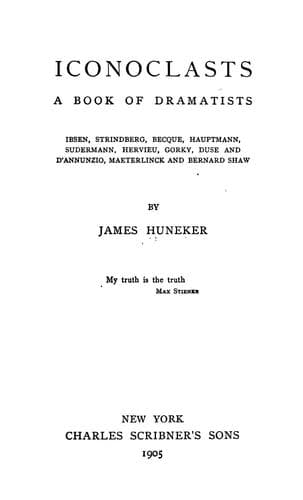
Iconoclasts: A Book of Dramatists: Ibsen, Strindberg, Becque, Hauptmann, Sudermann, Hervieu, Gorky, Duse and D'Annunzio, Maeterlinck and Bernard ShawHuneker, James
History
Iconoclasts: A Book of Dramatists: Ibsen, Strindberg, Becque, Hauptmann, Sudermann, Hervieu, Gorky, Duse and D'Annunzio, Maeterlinck and Bernard Shaw
Huneker, James
Dramatists; European drama -- 19th century -- History and criticism; European drama -- 20th century -- History and criticism
Her decision that, Judith-like, she will go forth to this Holophernes,
maddens her husband beyond endurance. In an exciting scene he accuses
her of knowing Prinzevalle, of being unfaithful to her marriage vows
in thought. He loads his father with opprobrium. The curtain falls on
Vanna as she leaves, Guido telling her that she will never return to
him the same.
Act II: Tent of Prinzevalle. We have admirable opportunities to study
the man's character, virile, upright, fearless, poetic, melancholy,
through his interviews with his faithful secretary and Trivulzio,
the emissary of the Florentine government. The siege has lasted too
long; Prinzevalle has waxed too powerful, a conspiracy has been formed
against him. He is to be deposed, assassinated. He finds all this in
his conversation with the lying, base Trivulzio. The episode has an
antique quality. Trivulzio attempts an attack, but is easily repulsed,
though he receives a slight wound in the face, warning Prinzevalle
meanwhile that by daybreak he will be deposed, ruined. There is nothing
left then but the improbable acceptance by Guido Colonna and his
virtuous spouse of the hard condition he has imposed upon them.
She approaches. She has been saluted by the sentries. Prinzevalle is
amazed. She is enveloped in a long cloak--beneath it she is a Lady
Godiva. The meeting is one of the most curious in dramatic literature.
Gustave Flaubert had anticipated it in Salammbô, but the daughter of
Hamilcar was a barbarian, after all, and Mâtho's love for her brutal.
The souls of Maeterlinck's pair are set before us with clearness,
force, and solemnity. The aptitude for dissection of motive displayed
by the poet in his previous work is revealed here with splendid
results. It is all natural--as natural as such a situation can be--and
the dismay of the noble woman is mitigated somewhat when she discovers
Prinzevalle has known her, has always loved her, that he means her no
harm. By degrees she extorts the truth from him.
Public-domain text, read in full here on John Shaqi.
Reviews
Reviews
No reviews yet
Be the first to share your thoughts on this work.
Elsewhere in the archive
Join the Discussion
Join the discussion
Sign in to leave a comment or review.
Sign InorCreate an account