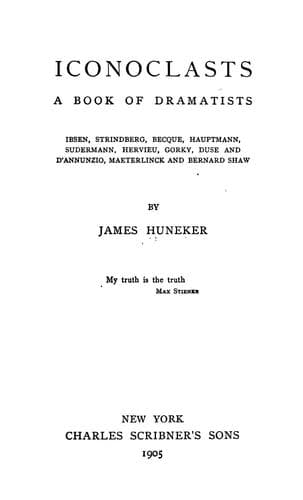
Iconoclasts: A Book of Dramatists: Ibsen, Strindberg, Becque, Hauptmann, Sudermann, Hervieu, Gorky, Duse and D'Annunzio, Maeterlinck and Bernard ShawHuneker, James
History
Iconoclasts: A Book of Dramatists: Ibsen, Strindberg, Becque, Hauptmann, Sudermann, Hervieu, Gorky, Duse and D'Annunzio, Maeterlinck and Bernard Shaw
Huneker, James
Dramatists; European drama -- 19th century -- History and criticism; European drama -- 20th century -- History and criticism
He is the playmate of her happiest hours; for her he has moved
mountains. Fresh from the insulting insinuations of her husband, her
head aflame with her exalted mission, she begins to see her life as
it really is. No, she does not precipitate herself into his arms! The
transition is infinitely more subtle than could be accomplished by most
modern playwrights. It is atmospheric. The dialogue leads us through
the avenues of this strangely reunited couple. _He_ is all passion
and tenderness. _She_--curiosity has given way to remembrance. At the
end he goes to Pisa with her, her captive; while radiant, unharmed,
she hastes to her husband and fellow-countrymen. The promised stores
have been sent; Prinzevalle deserts the cause of Florence--he is not a
Florentine, and as his life is in danger his defection may be pardoned.
And he loves. Stella Hohenfels in this scene quite surpassed herself
at the Hofburg Theatre, Vienna, where I witnessed a capital performance
of the play in 1903, with Joseph Kainz, Reimers, and others in the cast.
Daring as is this act, the next outgenerals it in surprises. Vanna
marches through the rejoicing city, lighted as for a feast. She is
conducted as a conqueror to her husband. Then begins the struggle. He
repulses her, heaping upon her vile phrases. Yes, she has saved Pisa,
but how? Where is the honour of the Colonna? She implores, explains,
denies, affirms. But when Guido learns the name of the silent warrior
who has accompanied her, his rage is boundless. It is her lover that
she hales back as a slave to show her triumph. There is enough meat
in this act to furnish forth a gross of modern nerveless, boneless,
bloodless abortions of drama now before the footlights. As a specimen
of the romantic drama with the accompaniment of a profound psychology,
Monna Vanna makes modern French works of the papier-maché type droop
like fresh flowers in a thunderstorm.
Incredulously the infuriated husband hears that Prinzevalle has made
no advances to Vanna. It is too much. Why, then, is he here? he
demands. He claims the head of Prinzevalle. Vanna jumps into the mob of
soldiers, crying that she has lied, lied abominably. Prinzevalle seized
her, she declares, and to defend herself she has wounded him. Behold
his face--which shows the marks of his struggle with the Florentine
emissary, Trevulzio.
Public-domain text, read in full here on John Shaqi.
Reviews
Reviews
No reviews yet
Be the first to share your thoughts on this work.
Elsewhere in the archive
Join the Discussion
Join the discussion
Sign in to leave a comment or review.
Sign InorCreate an account