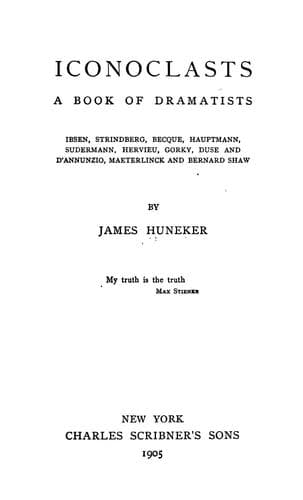
Iconoclasts: A Book of Dramatists: Ibsen, Strindberg, Becque, Hauptmann, Sudermann, Hervieu, Gorky, Duse and D'Annunzio, Maeterlinck and Bernard ShawHuneker, James
History
Iconoclasts: A Book of Dramatists: Ibsen, Strindberg, Becque, Hauptmann, Sudermann, Hervieu, Gorky, Duse and D'Annunzio, Maeterlinck and Bernard Shaw
Huneker, James
Dramatists; European drama -- 19th century -- History and criticism; European drama -- 20th century -- History and criticism
It is a striking situation. In the heyday of his glory Sardou
never devised anything more theatrically effective--setting aside
consideration of the psychologic imbroglio. Vanna then claims
Prinzevalle as her spoils of war. To the victor belongs the vanquished.
Colonna, despite Prinzevalle's assertion that Vanna's lie is another
lie, is handed over to the care of Vanna's people. In a swift
"aside" she commands silence. She loves him, she whispers. Marco
understands--understands the manner in which Vanna will be revenged
upon Prinzevalle and also upon her husband for his disbelief. The
latter now disclaims his former doubts. Let her work her vengeance
upon the man she has captured. But for her all that has gone before in
her entire life is as a bad dream. The real, the beautiful life, the
dream, is at hand. It will be her revenge. She must go at once to her
prisoner, to Prinzevalle in his cell--the curtain falls.
There are weak spots in the scheme which tax one's credulity.
Something of the improbable must be granted a dramatist be he never so
logical. The rapid mental change of Vanna hints at a nature naturally
casuistical, as were no doubt many Italians of the Renascence. Her love
for Colonna could never have been deep-rooted. But she did not betray
him, and yet she has been adjudged profoundly immoral--in a word,
not to put too fine an edge upon the sophistries of the situation,
this heroine committed an imaginative infidelity as well as telling a
falsehood. The madness of the finale is but the logical outcome of her
love for Prinzevalle. Few plays, however, reveal their complete essence
in the mere reading. And the cryptic stammering, the arrested spasms,
of Maeterlinck's earlier style vanish quite in the action of Monna
Vanna.
I have dwelt perhaps to lengths upon the spiritual development of the
man,--those who run may follow his material progress,--but the reason
is simple: the soul of Maeterlinck is in his plays. That he is a
creative thinker is not asserted. He has studied deeply the wisdom of
the ancients, of the moderns. He knows Emerson and Molière. He knows
Saint Teresa and John of the Cross. Conceive an artistic temperament
that seeks the phrase for itself as did Walter Pater; that loves
the soul of humanity as did Robert Browning; that seeks a dramatic
synthesis for his poetry, philosophy, rhetoric--and you have this man.
His Flemish _fond_ may account for his mystic temperament, for his
preoccupation with things of the spirit, and yet how difficult it is
to place the critical finger on this quality and that quality, as if
on the bumps of the phrenologist, and say--here is the real Maurice
Maeterlinck!
VI
Passers-by on the Boulevard, the summer of 1903, stared at the Gymnase
Theatre, which bore the inscription: Le Théâtre Maeterlinck. Certainly
such an institution as the Maeterlinck Theatre was undreamed of a
decade ago by the poet's most fanatical adherents.
Public-domain text, read in full here on John Shaqi.
Reviews
Reviews
No reviews yet
Be the first to share your thoughts on this work.
Elsewhere in the archive
Join the Discussion
Join the discussion
Sign in to leave a comment or review.
Sign InorCreate an account