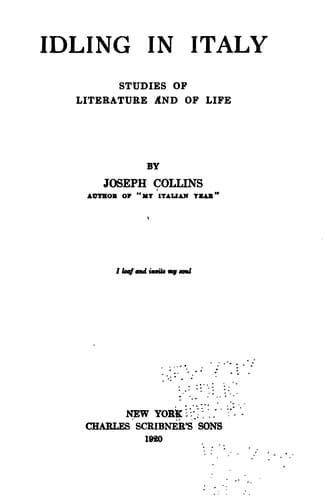
Idling in Italy: Studies of literature and of lifeCollins, Joseph
History
Idling in Italy: Studies of literature and of life
Collins, Joseph
Italian literature -- History and criticism
His students idolized him. When they left the university and returned to
their various spheres of activity they carried his image in their hearts
and sounded his praises with tongue or pen. They made propaganda con
amore. No one is ever approved of universally in any country, probably
least of any in Italy. When Carducci published his "Alla Regina
d'Italia" ("Ode to the Queen of Italy"), one of his best--simple,
musical, redolent of reverence and affection--he aroused the fury of the
republicans, who called him traitor, and the scorn of the envious, who
called him snob.
In 1891, when he accepted a senatorship of the realm, the students of
the University of Bologna howled and jeered at him, and many of the
former students plucked or tore his image from their hearts. They had
apotheosized the Great Commoner, and they saw in this truckling to
royalty and honors weakness and vanity which they could not believe that
he possessed. Yet in 1896, when he completed thirty-five years of
service at the university, the event was celebrated for three successive
days, and the outpouring of expressions of admiration and gratitude from
colleagues and students, and from heads crowned with laurel and gold,
has scarcely ever been paralleled.
In an autobiographical sketch in the volume of "Poesie," of 1871, he
relates with great detail the way in which he broke from his early
parental teachings and acquired his new literary, political, and
religious feelings. Following his Hellenic instincts, the religious
trend in him was toward the paganism of the ancient Latin forefathers
rather than toward the spirituality that had come in with the infusion
of foreign blood. He rebelled against the passive dependence on the fame
of her great writers, in which Italy had lived in the apathy of a
long-abandoned hope of political independence and achievement. The
livery of the slave and the mask of the courtesan disgusted him. His was
the hope and joy of a nation waking to a new life. He was the poet of
the national mood.
Carducci is little known as a poet in this country. There are many
reasons why his fame has not made headway in Anglo-Saxon countries. In
the first place, he has not been extensively translated, and in the
second place, although the subject of his song was so often liberty, his
lines are so replete with erudite classic illusions that even though he
could be translated he would be found to be hard reading. But more than
all there is probably no poet whose matter loses so much of its music
and its fire by translation as Carducci. Such exquisite verses as the
"Idylls of the Lowlands," "The Ox," "The Hymn to the Seasons," "To the
Fountains of Clitumnus" are translatable. It would require a Longfellow
to do it so that they should not be emasculated.
Public-domain text, read in full here on John Shaqi.
Reviews
Reviews
No reviews yet
Be the first to share your thoughts on this work.
Join the Discussion
Join the discussion
Sign in to leave a comment or review.
Sign InorCreate an account