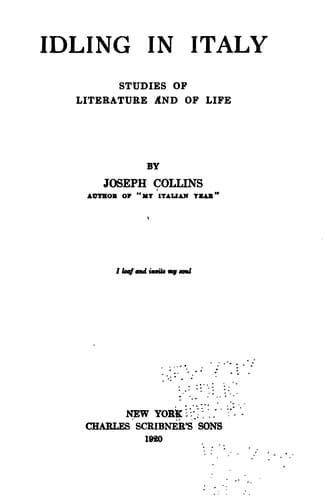
Idling in Italy: Studies of literature and of lifeCollins, Joseph
History
Idling in Italy: Studies of literature and of life
Collins, Joseph
Italian literature -- History and criticism
In 1906 he was awarded the Nobel prize for literature and the entire
literary world approved of the reward. Two years previously he had
resigned his professorship, and parliament voted him a pension of twelve
thousand lire a year for life, but it was of short duration, for he died
in 1907.
Mario Rapisardi, to whom a monument has been erected in his native town
of Catania, and who is known best for his tragedy "Manfredi" and his
philosophic poem, "La Palingenesi," and "Poesie religiose," was a
ferocious critic of Carducci. In his poem entitled "Lucifer" there are
many disparaging allusions to him. Rapisardi was a teacher and a poet,
but a spiritual chameleon: a devout believer, he became a radicalist; a
monarchist, he became a socialist; a romanticist, he became a
classicist. He is one of the best specimens of the old order of poets.
His "Falling Stars" and "The Impenitent" have a genuine lyric quality,
and such poems as "To a Fire-fly" have movement, rhythm, and luminosity
that are impressive.
The only poet that approximated Carducci's stature was Giovanni Pascoli
(1855-1912). Though he was a few years younger, the period of his
literary activity was contemporaneous. When Carducci died, Pascoli
succeeded him for a few years in the University of Bologna. His personal
story appealed tremendously to Italians, and he was of the masses in
appearance and sentiment. After the assassination of his father by an
unknown hand the family suffered great poverty, and as a boy the support
of two younger sisters fell upon him, and like so many of the talented
young men of Italy he accomplished it by teaching school. He was
teaching in the high school of Leghorn in 1892 when he published
"Myricae," upon which to-day his fame rests most securely. His verses
gave him an immediate celebrity, and he was soon made professor of Latin
and Greek in the University of Messina. From there he went to Pisa and
soon afterward to Bologna.
Pascoli has been called the greatest Latin poet after Virgil. Some of
the titles of his volumes are "Poemetti" ("Little Poems"), "Poemi
Conviviali" ("Convivial Poems"), "Odi e Inni" ("Odes and Hymns"), "Canti
di Castelvecchio" ("Songs of Castelvecchio"), "Nuovi Poemetti" ("New
Little Poems"), "Poemetti Italici" ("Little Poems of Italy"), "Le
Canzoni di Re Enzio" ("The Songs of King Enzio"), and an interpretative
volume of Dante entitled "Sotto il Velame" ("Beneath the Veil").
Despite the fact that he was an advanced political thinker, he taught
his students to respect the law. He was the poetical evangelist of the
humble, of the unfortunate, and of the physically venturesome. He sang
of the cravings of the soul, of the problems of existence, of Christian
acceptation, of the glory of Italy and the accomplishments of her sons.
Posterity, however, is whispering that the name most worthy to be
bracketed with Carducci is Gabriele D'Annunzio. I shall consider him in
another chapter.
Public-domain text, read in full here on John Shaqi.
Reviews
Reviews
No reviews yet
Be the first to share your thoughts on this work.
Join the Discussion
Join the discussion
Sign in to leave a comment or review.
Sign InorCreate an account