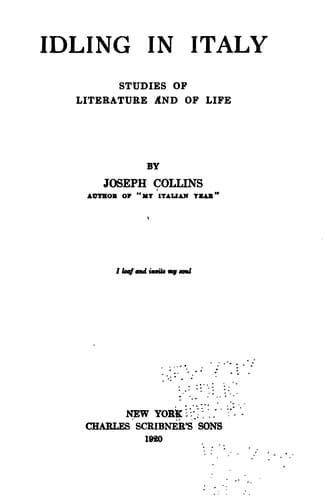
Idling in Italy: Studies of literature and of life — John Shaqi
Idling in Italy: Studies of literature and of lifeCollins, Joseph
History
Idling in Italy: Studies of literature and of life
Collins, Joseph
Italian literature -- History and criticism
There is a name in the literary annals of this period that is steadily
gaining claim to immortality. It is Giovanni Verga, the chief exponent
of the Veristic school, who was born at Catania in 1840 and is still
living. Although it is the opinion of those who are competent to judge
that his fame as a novelist is greater than that of Fogazzaro, it may
truthfully be said that he is scarcely known beyond the confines of
Italy, and even there his romances have not had the reception that they
deserve. A few years ago when I asked for a copy of "Mastro-don
Gesualdo" in the leading bookshop of Palermo and was not successful in
obtaining it, the young man with whom I talked assured me that Zuccoli
would prove to be a satisfactory substitute for Verga. If he is known at
all in this country, it is as the author of the play entitled
"Cavalleria Rusticana," upon which was composed the popular opera. He
has not been a very prolific writer--eight romances, half a dozen
volumes of short stories, and a few plays. He got the material for many
of his short stories in central and northern Italy, but most of his
romances are of his native Sicily, and the pictures of life in the
little villages and towns in the houses of the passionate peasants, in
the huts of the poverty-stricken shepherds, in the hovels of the
adventurous fishermen, and the crumbling palaces of the decayed nobles
are so realistic, so true to life, so almost photographically depicted,
that the reader feels that they are mediated by his own senses. Verga
has the supreme faculty of creating men and women that the reader has
met or would like to meet.
If realism consists in depicting people as they are and particularly
people who are battling with the stern realities of life--poverty,
illness, passions--then Verga is a great realist. The best of his
romances, though not the most popular, are "I Malavoglia" and
"Mastro-don Gesualdo." "Tigre Reale" had the greatest popularity, and
the "Storia di una Capinera" ("The Story of a Black-hood Novice"), the
most ardently romantic of all romantic stories, and "Il Marito di Elena"
("The Husband of Helen") were widely read.
"I Malavoglia" and "Mastro-don Gesualdo" were to have been succeeded by
a third volume which would complete the story of the characters unfolded
in them, but it never appeared. When we recall that only eight thousand
copies of the former have been sold in forty years, we readily
understand the artist's discouragement. Posterity is likely to link
Verga's name with Leopardi and Manzoni.
Public-domain text, read in full here on John Shaqi.
Reviews
Reviews
No reviews yet
Be the first to share your thoughts on this work.
Join the Discussion
Join the discussion
Sign in to leave a comment or review.
Sign InorCreate an account