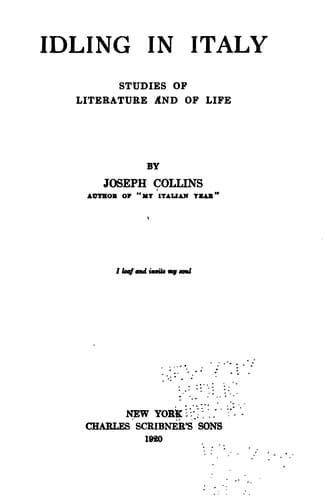
Idling in Italy: Studies of literature and of lifeCollins, Joseph
History
Idling in Italy: Studies of literature and of life
Collins, Joseph
Italian literature -- History and criticism
His first books, "Memorie inutili" ("Useless Memories"), "Sullo Scoglio"
("On the Reefs"), and "Al di la, no" ("The Next World, No"), revealed
such unbridled license of morbid tendencies that even Italians could not
stomach them. He appeared to them a romanticist after the manner of
Guerrazzi, addicted to the Macabre, subject to satanic inspiration,
bombastic, and rhetorical.
When Oriani took up a second phase of his writing in the period from
1880 to 1890 the reading public still continued to mistrust him.
Although he brought his spirit to a more stable equilibrium, he carried
upon himself the stigma that clung to him in consequence of his previous
books, and such productions as "Il Nemico" ("The Enemy"), "Incenso e
Mirra" ("Incense and Myrrh"), "Fino a Dogali" ("Up to Dogal"),
"Matrimonio e divorzio" ("Marriage and Divorce"), did not absolve him
from previous sins.
His turgid style was more objected to than his taints and his themes,
and his aggressiveness and political arrogances found greater opposition
than his early decadent manner and his late negations in religious
matters. He was accused of being a plagiarist. His greatest work "Lotta
Politica" was characterized by a critic, L. Ambrosina, to be wholly
devoid of originality. His "Momo" was called an imitation of
Turgénieff's "A Neighbor's Bread." His "L'Invincibile" was derived from
"Andrea Cornelis" of Paul Bourget, and the "Ultimi Barbari" ("The Last
Barbarians") from Verga's "Pagliacci" and the "Cavalleria Rusticana."
Thus beset, Oriani, despairing of recognition, gathered his strength for
a final flight and strove to reach heights never reached before, and he
wrote "The Political Struggle," "Holocaust," and "Ideal Revolts."
"The Holocaust" is a study of mother and daughter. The mother has, from
leading a wayward life, been able to keep body and soul together until
middle age has effaced her charms. Reduced to hunger and rags, she
decides to sacrifice her fifteen-year-old daughter and offers her to the
first stranger whom she encounters walking beside the Arno one evening;
she takes him to her contemptible rooms where the emaciated and ragged
child awaits, in ignorance of her mission, the mother.
Public-domain text, read in full here on John Shaqi.
Reviews
Reviews
No reviews yet
Be the first to share your thoughts on this work.
Join the Discussion
Join the discussion
Sign in to leave a comment or review.
Sign InorCreate an account