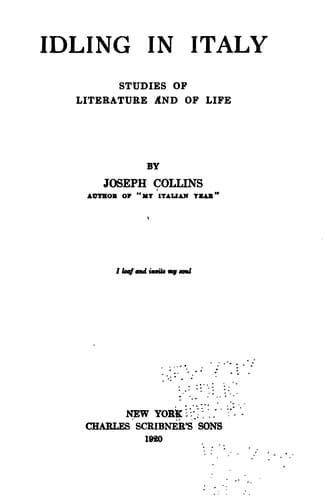
Idling in Italy: Studies of literature and of lifeCollins, Joseph
History
Idling in Italy: Studies of literature and of life
Collins, Joseph
Italian literature -- History and criticism
His fame rests on his dialect poetry ("Poesie"), chiefly in sonnet form,
in which he depicts the virtues and vices, the licenses and inhibitions,
the hopes and the despairs, of his fellow Tuscans, at the same time
embodying delightful descriptions of their charming, romantic land; and
a few small volumes of prose, all little masterpieces--"Napoli a occhio
nudo" ("Naples to the Naked Eye," letters written to a friend about that
enchanting city two generations ago when it was still plunged in the
misery of its protracted predatory misrule and the majority of its
inhabitants were reduced to a deplorable state); "All' Aria Aperta" ("In
the Open Air"), scenes and incidents of life among the common people of
Tuscany; and "Le Veglie di Neri" ("Fireside Evenings of Neri"), which
showed him a man of heart and of mind supremely capable of transforming
the messages of the former by the latter in such a way as to make great
appeal to his fellow beings. His books can be read to-day with the same
pleasure that they were read half a century ago, and the pictures which
are painted, particularly in the former, are as vivid as the day they
were first put on the canvas.
Fucini is a type that is indigenous to central Italy, by nature a lover
of the fields, the forest, the brooks, he was compelled from earliest
infancy to earn his living, and he seemed to be content with a bare
sustenance, getting pleasure from his wanderings and from books. He did
on foot and more intimately what Signore Panzini has done on a bicycle
or on way trains. As an inspector of country schools he was obliged to
visit countless villages and hamlets, and there he found in the habits,
customs, and conduct of their inhabitants material for comment and
reflections such as most people find in new countries and large cities.
His descriptions of them found sympathetic response in the hearts of
many who see in the lives of these simple yet sophisticated people the
romance of bygone days.
Fucini has not cut a great figure in Italian letters, but any one who
would get a familiarity with the literature of the early days of Italian
unity, or who is in search of diversion and delight should not neglect
him. He is a sympathetic figure, whether wandering through Tuscany,
bending over a table in the Riccardi Library, or awaiting his cue at
Empoli.
A writer of this period to whom posterity is likely to give a high
rating is Alfredo Oriani, who died in 1907. His fame will finally rest
on his fiction rather than on his historical contributions. Though "La
lotta politica in Italia" ("The Political Struggle in Italy"), from 486
to 1877 in three volumes, is a creditable performance, it is not based
on personal research. Malignant-minded critics have occupied themselves
with proving him a pilferer, but the work is done with such consummate
literary skill that he has put the reading world under obligations to
him.
Public-domain text, read in full here on John Shaqi.
Reviews
Reviews
No reviews yet
Be the first to share your thoughts on this work.
Join the Discussion
Join the discussion
Sign in to leave a comment or review.
Sign InorCreate an account