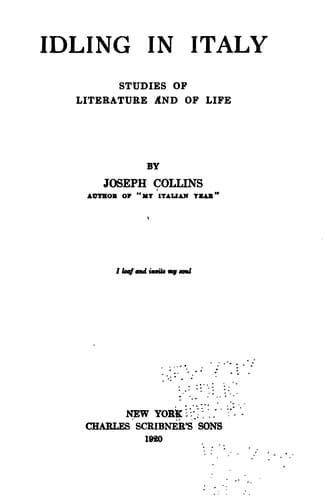
Idling in Italy: Studies of literature and of lifeCollins, Joseph
History
Idling in Italy: Studies of literature and of life
Collins, Joseph
Italian literature -- History and criticism
Marco Praga is the son of Emilio Praga, who was the best-known Bohemian
poet of Italy in his day (1839-1875), but who abandoned writing to teach
dramatic literature in the Conservatory of Music in Milan. He professes
to be the dramatic mirror held up to life and to tell the truth as he
sees it, that he cannot be persuaded to camouflage it, and that when it
is depicted on the stage it shall amuse rather than distress. That is
what makes his most successful plays, such as "Le Vergini" ("The
Virgins") and "La Moglie Ideale" ("The Ideal Wife"), depressing reading.
Such conduct as they depict and such exchange of thought and sentiment
as they report undoubtedly exist, but the less one knows of it and comes
in contact with it the happier he or she is likely to be. If adultery
could only be made a virtue for a few years, it would lose its
attractiveness and many writers would have to earn their living.
At the end of the nineteenth century Italy had three women poets of much
distinction, one of whom, Ada Negri, had and still has great popularity.
Her last book of poems, "Il libro Di Mara" ("The Book of Mara"), has
shown that she still has the capacity to put into verse dramatically and
lyrically the most delicate and the most dominant notes of love as she
or as those she has loved has experienced it. She was born in a little
village of Lombardy in 1870. Her mother worked in a factory, and she
herself was for some years a teacher in the elementary schools; so she
had first-hand knowledge of the shut-in life of those whose repressions
and aspirations she sung and published in _L'Illustrazione Popolare_ of
Milan. In these she set forth with great sincerity and with stirring
lyric quality the sordid sufferings and sorrows of the toiling masses.
These poems and others were published under the titles of "Fatality" and
"The Tempest" in 1892 and 1894. Two years later a radical change in her
social and spiritual environment was brought about by her marriage to
Signor Garlanda, and soon she sang of it in a volume called "Maternity,"
which does for that state what her previous volumes had done for human
pain and human poverty. "Dal Profondo" ("From the Depths") was but a
continuation of these sentiments, tinctured with philosophical and
socialistic knowledge that had been displayed for other purpose in "The
Tempest." After this came a volume entitled "Esilio" ("Exile"), which
reflected the same thoughts and sentiments in Swiss light. She has
written two prose works, a series of short stories entitled "Le
Solitarie" and "Orazioni" ("Orisons"). She glorifies purity, idealizes
it, and sings its adoration.
Public-domain text, read in full here on John Shaqi.
Reviews
Reviews
No reviews yet
Be the first to share your thoughts on this work.
Join the Discussion
Join the discussion
Sign in to leave a comment or review.
Sign InorCreate an account